AI Coding Agents vs Vibe Coding: What Is the Difference and What Can You Delegate?
Learn how AI coding agents work, how agentic development differs from vibe coding, which tasks can be delegated, and how to review results safely.
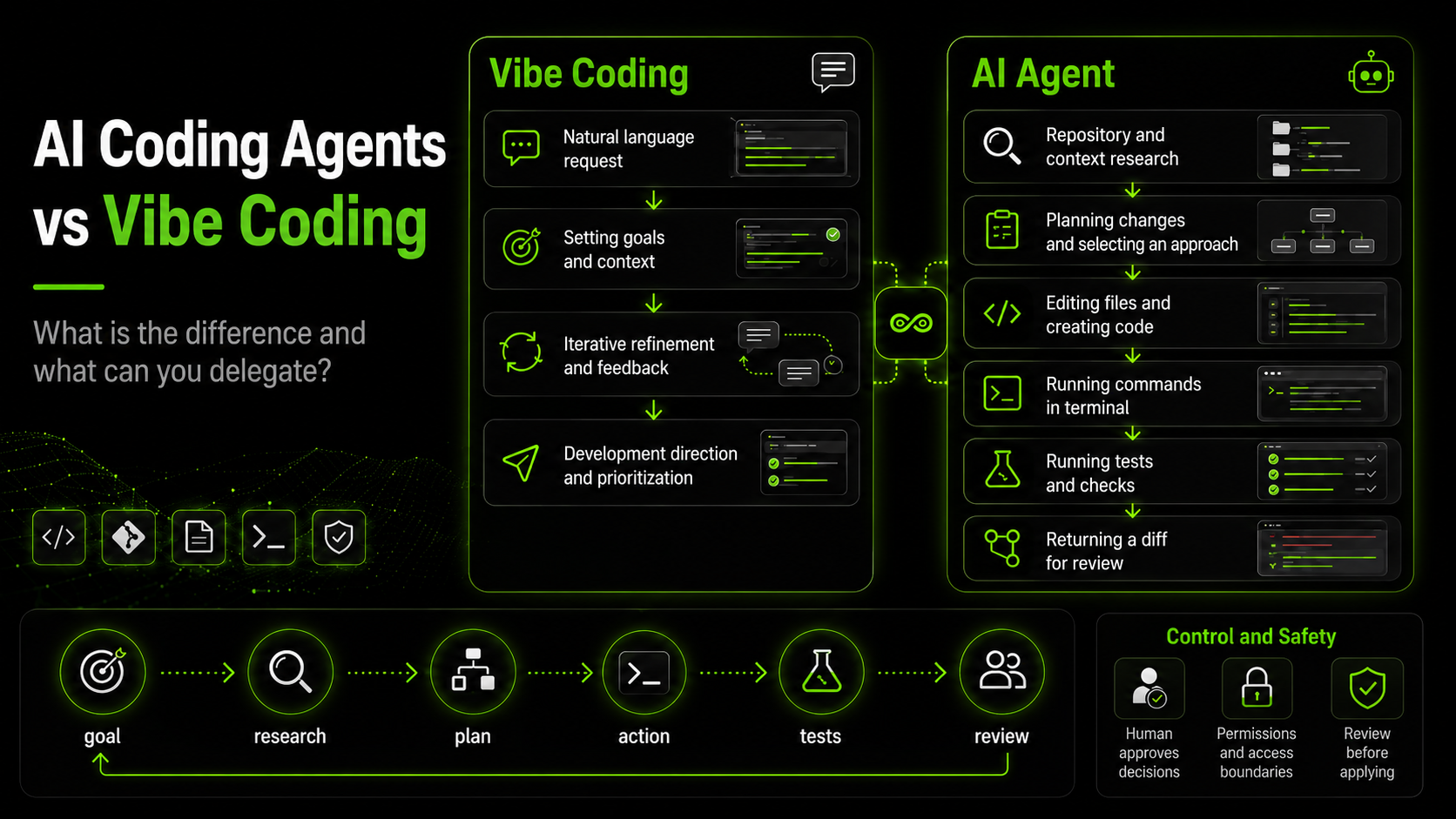
In brief
- • Vibe coding describes how a person communicates desired outcomes through natural language, while an AI agent receives tools to perform a sequence of actions.
- • An agent may inspect a repository, modify several files, run commands, observe failures, and revise its implementation.
- • The level of autonomy depends on the tool, permission mode, and access to the development environment.
- • The more actions an agent can perform, the clearer the goal, scope boundaries, and acceptance criteria must be.
- • Agents work best on limited engineering tasks with verifiable outcomes.
- • Payments, authentication, access control, production migrations, and infrastructure require stronger human review.
- • A successful build and passing tests do not guarantee that the business rules were understood correctly.
- • AI agents should receive the minimum permissions required and should not receive production secrets without a clear need.
- • Results should be reviewed through diffs, tests, builds, user flows, and risk analysis.
- • Responsibility for architecture, security, and the final product always remains with a person.
ContentsShow sections
AI tools for software development have changed quickly.
At first, a developer asked a chatbot a question, received a code snippet, and manually copied it into a project. Later, editors gained the ability to modify selected files. Modern coding agents can now inspect repositories, create plans, run commands, observe errors, and continue working within the permissions they receive.
As a result, terms such as vibe coding, AI development, and agentic development are often used as though they mean the same thing.
They do not.
Vibe coding describes how a person communicates desired outcomes to AI through natural language and iterative feedback.
An AI coding agent describes a technical system that receives instructions together with tools for performing actions.
The same developer may use both approaches at the same time.
What is vibe coding?
Vibe coding is a workflow in which a person describes the desired product behavior in natural language and uses AI to create or modify the implementation.
For example:
Add order history to the customer dashboard, include a status filter, and allow customers to repeat a previous order.
The person may then:
clarify the interface;
change the behavior;
provide an error;
request mobile support;
add access control;
revise the output.
The main characteristic is that the work is directed through goals and expected outcomes rather than manual control over every line.
Vibe coding does not define how independently the AI acts.
A developer may use:
a regular chat;
an AI editor;
a terminal tool;
a local coding agent;
a cloud agent;
several agents in parallel.
For a broader introduction, read “Who Are Vibe Coders?”.
What is an AI coding agent?
An AI coding agent receives access to tools and can perform a sequence of actions to complete a development objective.
Depending on the product and permissions, an agent may:
read files;
search the codebase;
inspect dependencies;
edit several files;
create files;
run commands;
install dependencies;
execute tests;
run builds;
inspect logs;
perform Git operations;
prepare a diff;
create a pull request;
return a work report.
Modern coding agents may work locally in a terminal or editor and may also execute delegated tasks in cloud environments. Codex supports local workflows, cloud background tasks, parallel agents, and worktrees. Claude Code supports project file access, command execution, tool restrictions, and permission modes.
The main difference from a normal chat is that the agent can perform an action, observe the result, and continue.
AI coding agents and vibe coding compared
Criterion | Vibe coding | Agentic development |
|---|---|---|
What it describes | Human interaction with AI | Technical execution of software work |
Main input | Goals and feedback in natural language | Goal, context, tools, and constraints |
File changes | May be manual or AI-assisted | Usually performed by the agent |
Commands | Often run by the person | May be run by the agent |
Error handling | The person may return the error | The agent can observe command output |
Task length | Often short iterations | May involve a longer action chain |
Permissions | Depend on the selected tool | Central to the workflow |
Responsibility | Human | Human |
Review requirement | Mandatory | Mandatory |
The approaches are not competitors.
A vibe coder may describe a goal in natural language, delegate implementation to an agent, and review the result.
How is an agent different from code generation?
A normal model may receive this request:
Write a function that prevents duplicate order creation.
It may produce useful code, but it may not know:
which file contains the order logic;
how the database is structured;
which tests already exist;
which endpoints call the function;
which project conventions must be preserved.
The developer needs to collect the context and apply the answer.
An agent may instead:
Locate the order handler.
Inspect the data model.
Review existing constraints.
Find related tests.
Prepare a plan.
modify the backend logic.
Add a repeated-request test.
Run the tests.
Observe a failure.
Revise the implementation.
Present the final diff.
OpenAI describes this interaction between user instructions, the model, and executable tools as an agent loop.
How does the agent loop work?
A simplified loop looks like this:
goal → research → plan → action → observation → revision → verification
Goal
The person describes the required outcome.
Research
The agent inspects the repository and identifies related logic.
Plan
The agent determines the expected changes and checks.
Action
It edits files or runs commands.
Observation
The tool returns a result:
the test passed;
the build failed;
the file was not found;
types do not match;
the command returned an error.
Revision
The agent adds this information to the context and continues.
Verification
It runs the agreed checks and returns the result for human review.
One user message may produce many internal actions. Clear boundaries and stopping criteria therefore matter.
Levels of AI autonomy
Autonomy is not a simple on or off setting.
Level 1. Suggestion
AI explains a solution or generates a code fragment.
The person:
selects the file;
applies the change;
runs commands;
fixes errors.
Level 2. File editing
AI can modify selected files, while the person confirms important actions.
This works well for:
small refactors;
type corrections;
copy changes;
component updates.
Level 3. Agentic task
The agent receives a goal and investigates the relevant part of the repository.
It may:
modify several files;
execute tests;
fix related failures;
prepare a report.
The person accepts or rejects the result.
Level 4. Background task
The work is performed separately from the developer's active session.
The agent may return:
a branch;
a diff;
a pull request;
a report;
a list of risks.
Codex cloud tasks, for example, run in separate isolated environments containing the repository before returning changes for review.
Level 5. Multiple agents
Several agents work on separate tasks in parallel.
For example:
one agent modifies the backend;
one adds tests;
one updates documentation;
one reviews the output.
This may accelerate independent work, but it requires careful decomposition and integration.
Tasks that suit AI coding agents
Agents perform best when the scope is limited and the result is verifiable.
Repository exploration
Examples:
find where roles are checked;
explain the payment flow;
map module dependencies;
locate the cause of a repeated request;
list application routes.
An agent may explore an unfamiliar repository faster than a developer opening it for the first time.
Fixing a limited defect
Strong task:
Prevent duplicate request creation after a double click. Do not modify the database structure or public API. Add a test for two identical requests.
Weak task:
Fix everything that is wrong.
Repetitive refactoring
Examples:
replace a deprecated component;
update imports;
change logging format;
extract a repeated validation;
add the same field to several forms.
Test preparation
An agent may:
inspect the existing style;
add unit tests;
prepare an integration scenario;
create a regression test;
run the test suite.
The tests still require review. An agent may create a test that confirms its own incorrect assumption.
Build and type failures
Suitable tasks include:
TypeScript failures;
invalid imports;
deprecated APIs;
dependency conflicts;
broken production builds;
schema and type mismatches.
Documentation
An agent may:
update README files;
document environment variables;
prepare setup instructions;
synchronize documentation with code;
describe an API.
Pull request preparation
It may help:
summarize changes;
explain checks;
list risks;
prepare a review description.
Tasks that require stronger human control
Some tasks can be delegated only as preparatory work.
Payments
Defects may cause:
duplicate charges;
incorrect order states;
repeated product delivery;
broken refunds;
financial inconsistencies.
Server confirmation, duplicate events, and idempotency need separate verification.
Authentication
Dangerous failures include:
access to another account;
incorrect role checks;
sessions that never expire;
user impersonation;
unsafe account recovery.
Access control
A passing interface test does not prove that a regular user cannot call an administrative endpoint directly.
Server-side permissions must be verified.
Production database migrations
An agent may prepare a migration, but it should not automatically run against production.
Review:
data loss;
table locking;
rollback;
execution time;
compatibility with the previous application version;
backup availability.
Data deletion
Bulk deletion, account removal, and record transformation require confirmation and recovery planning.
Infrastructure and deployment
An agent should not freely:
modify a firewall;
restart production;
remove containers;
change DNS;
expose secrets;
disable backups.
Smart contracts and financial logic
These changes require specialized review, edge-case testing, and independent verification.
Why passing tests do not guarantee correct behavior
Consider this task:
Charge the platform fee after the transaction is completed.
The agent may implement the fee and create a test for the implementation.
The tests pass.
However, the real business rules may be:
the fee applies only to protected transactions;
direct transactions have no platform fee;
cancelled transactions should not be charged;
a repeated webhook must not create another charge.
When the context is incomplete, an agent may implement the wrong business model correctly.
Two levels of review are required:
Technical correctness.
Business-rule correctness.
How to write a strong task for an agent
The more autonomy the agent receives, the clearer the boundaries should be.
Goal
What must change after the task?
Weak:
Improve authentication.
Stronger:
After a user's role changes, an old token must not preserve administrative access.
Context
Explain where the relevant logic is and how it currently works.
The role is stored in the JWT at sign-in. Server actions trust the token value.
Problem
Describe reproducible incorrect behavior.
When an administrator is downgraded, the existing JWT still grants access to administrative actions.
Scope
State which areas may be modified.
You may change server-side role validation and tests. Do not change the token format or client navigation.
Prohibited changes
Record important restrictions.
Do not disable authentication, add bypass flags, or modify roles in the database.
Acceptance criteria
Describe an objective result.
After a role change, the next server request using the old token returns 403.
Checks
List required commands and scenarios.
Run authentication tests, type checking, and the production build.
Output format
State what the agent should return.
Show the plan first. After implementation, list modified files, test results, and remaining risks.
Copyable agent task template
Goal
Which result is required?
Context
Where is the relevant logic and how does it currently work?
Problem
How can the incorrect behavior be reproduced?
Scope
Which modules and files may be changed?
Restrictions
Which parts of the system must not change?
Acceptance criteria
How will the result be verified?
Checks
Which tests, builds, and user scenarios must be executed?
Risks
Which data, payments, or permissions may be affected?
Output
Should the agent return a plan, diff, report, change list, and verification instructions?
Restricting agent access
AI agents should receive the minimum access required for the task.
Modern tools provide permission controls. Claude Code can allow or deny specific tools, limit agentic turns, and start in a selected permission mode. Codex uses sandboxing and approval mechanisms to control actions.
Use Git
Before the task:
create a branch;
confirm that the working directory is clean;
save current changes;
prepare a rollback path.
Use an isolated environment
Options include:
sandbox;
container;
separate worktree;
temporary database;
test project;
isolated cloud environment.
Do not provide unnecessary secrets
An agent may not need:
production API keys;
administrator passwords;
wallet seed phrases;
payment credentials;
real user data;
unrestricted SSH access.
Use test values and limited accounts.
Restrict dangerous commands
Require approval for:
deleting files;
infrastructure changes;
migrations;
deployment;
package publication;
message delivery;
financial operations.
Limit network access
When a task does not require external internet access, unrestricted networking may be unnecessary.
Keep production separate
Production deployment should remain a separate reviewed step.
Reviewing an agent's result
1. Read the explanation
Confirm that the agent understood the objective and did not change it during implementation.
2. Review modified files
Unexpected changes require investigation.
A copy change should not alter the database schema.
3. Inspect the diff
Look for:
removed validation;
weakened types;
disabled error handling;
new dependencies;
public API changes;
secret handling;
authorization bypasses;
temporary workarounds.
4. Run linting and type checks
These catch part of the structural problems.
5. Run tests
Review:
existing tests;
new tests;
edge cases;
repeated requests;
incorrect permissions;
invalid inputs.
6. Create a production build
Development mode may hide build-time problems.
7. Complete user flows
Review the product as a user rather than only as a developer.
8. Test negative scenarios
What happens when:
permission is missing;
a request is repeated;
the network fails;
data is invalid;
an external service is unavailable;
the user clicks twice?
9. Inspect logs
The system should not hide important failures or expose secrets.
10. Confirm rollback
Before merging, understand how to return to the previous state.
Why multiple agents may not be faster
Parallel agents are useful for independent tasks.
Strong example:
agent 1 updates documentation;
agent 2 adds tests for an isolated module;
agent 3 fixes an unrelated interface.
Weak example:
three agents modify authentication;
two agents create different migrations for one table;
several agents edit the same component;
one agent changes an API without informing the others.
Possible problems include:
conflicts;
duplicated work;
incompatible architecture;
inconsistent dependencies;
complex integration.
A multi-agent workflow requires:
Task decomposition.
Ownership for each module.
Shared contracts.
Separate branches or worktrees.
Integration review.
A complete test suite.
What clients should know
Clients do not need to understand every coding agent.
They should ask the contractor:
Who owns the architecture?
Which tasks are delegated to AI?
How are changes reviewed?
Who reads the diff?
Which tests are run?
How is security reviewed?
Where does the agent execute?
Does it receive production access?
Who owns the repository?
Who fixes post-launch defects?
A weak question is:
Did you write the code yourself or use AI?
A more useful question is:
Can you explain how the system works, show the verification process, and take responsibility for the result?
What vibe coders should know
A coding agent should not turn the developer into a messenger between an error and a model.
Weak process:
The agent creates an error.
The developer copies it back.
The agent suggests a random fix.
The cycle continues until the message disappears.
Nobody reviews adjacent behavior.
Strong process:
Reproduce the problem.
Identify the likely cause.
Restrict the change scope.
Request a plan.
Review the diff.
Run tests.
Complete the user flow.
Record the result in Git.
Prepare rollback.
The ability to work with agents is measured by task control rather than prompt volume.
Does AI reduce development cost?
AI may accelerate:
code discovery;
repetitive edits;
test preparation;
documentation;
simple bug fixes;
repository exploration.
Project cost still depends on:
business complexity;
feature count;
integrations;
security;
testing;
publishing;
maintenance;
contractor responsibility.
Clients do not pay for the number of manually typed lines.
They pay for a working, verified, and maintainable result.
Agentic development therefore does not guarantee that every complex product becomes inexpensive.
Evaluating AI developers on VibeMarket
VibeMarket clients can review:
specialization;
working products;
personal contribution;
screenshots;
videos;
available verification;
reviews;
work process.
A project request should include:
the goal;
business rules;
permitted technologies;
acceptance criteria;
testing requirements;
repository handover;
access restrictions.
A contractor may use AI agents, but responsibility for implementation remains with the contractor.
Developers can create a VibeMarket profile and present real products, personal contribution, and review practices rather than only listing AI tools.
Final thoughts
Vibe coding and agentic development describe different parts of one workflow.
Vibe coding answers:
How does a person communicate the desired result to AI?
Agentic development answers:
Which actions may AI perform in the development environment?
An AI coding agent can inspect a repository, edit files, run commands, observe failures, and continue working.
It does not accept responsibility for the product.
A person must still:
define the goal;
explain the business rules;
restrict access;
review the plan;
inspect the diff;
run checks;
accept the result;
take responsibility for the consequences.
The more autonomy an agent receives, the more important engineering control becomes.