Can You Trust a Vibe Coder to Build an MVP?
When a vibe coder is a good fit for an MVP, what to control at each milestone, and how to budget the first working release.
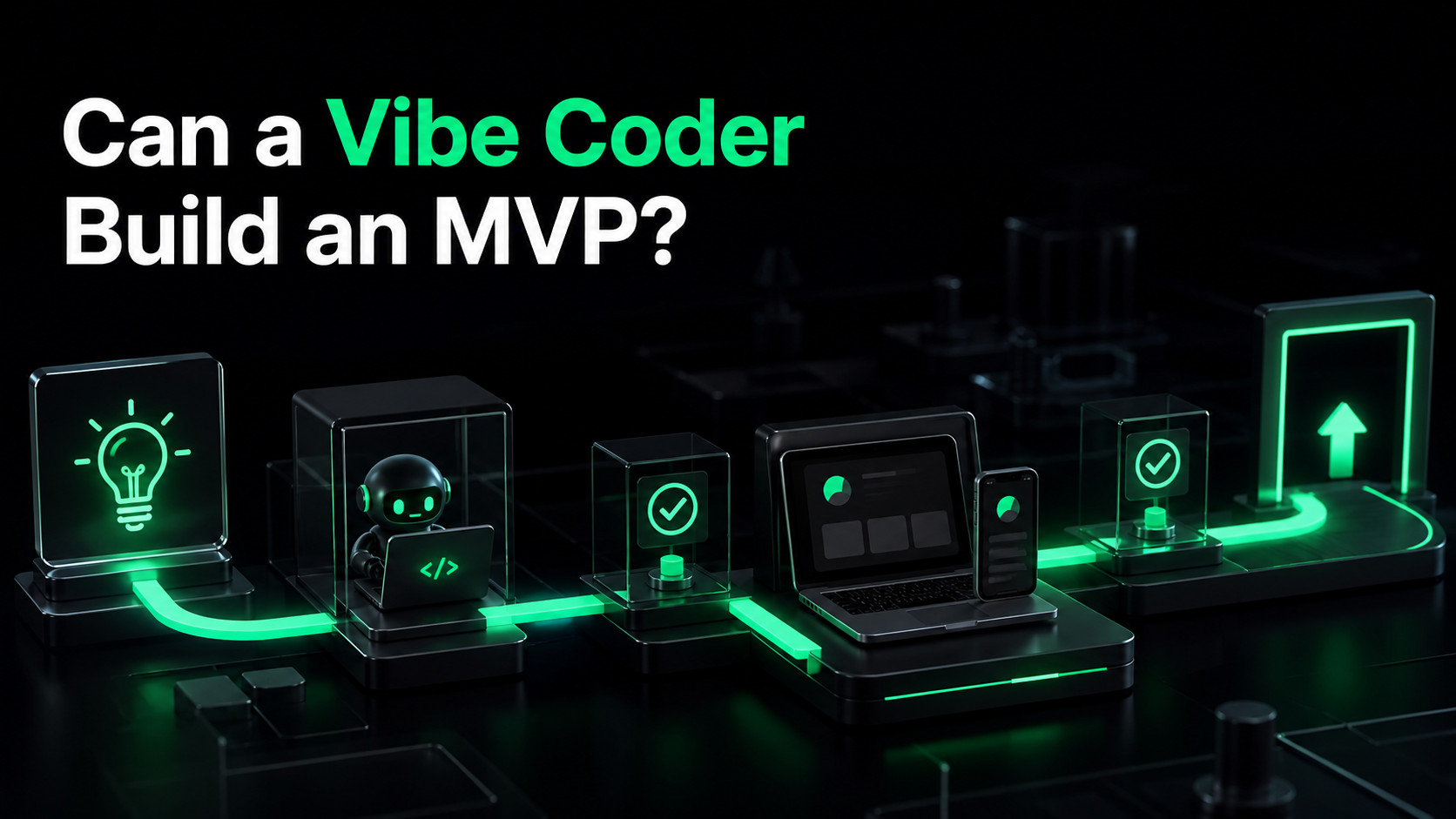
In brief
- • An MVP is a good vibe coder project when it tests one hypothesis through a bounded core flow.
- • Define the user, value event, and success criteria before coding.
- • Payments, roles, and personal data add real requirements even to a small release.
- • Without staging, repository access, and tests, a fast MVP becomes an expensive prototype.
- • A prototype / proof of concept is often $500–$1,500, while a complex MVP with several flows may reach $8,000–$18,000.
ContentsShow sections
Yes, a vibe coder can build an MVP, but only when the MVP is genuinely minimal. If the first release already includes teams, billing, mobile apps, advanced analytics, and many integrations, it is no longer a small hypothesis test. It is a production product with real engineering risk.
When it is a good fit
- there is one primary user and one core flow;
- the release tests demand rather than covers the whole market;
- data and payments can be limited or kept in a safe test environment;
- the client can review a result every week;
- there is a post-launch budget for fixes and user feedback.
Define this before coding
Do not start with a list of screens. Define the value event: a user submits a request, receives a result, pays for a subscription, or completes a work process. Then define the data, roles, and failure states needed for that event.
Milestones you should not skip
- Outline: roles, data, primary flow, and boundaries.
- Vertical slice: one journey from entry to outcome.
- Test environment: separate keys, test payments, and repeatable deployment.
- Acceptance: real scenarios, errors, mobile behavior, and access ownership.
- Launch: monitoring, backups, and a fix plan.
MVP budget
| Level | Guideline | Typical scope |
|---|---|---|
| Prototype / proof of concept | $500–$1,500 | Idea validation and a demonstrable flow |
| Small working MVP | $2,000–$6,000 | One core flow, database, basic auth, and deployment |
| MVP with roles, admin, and integrations | $4,000–$10,000 | Several roles, data management, and 1–3 integrations |
| Complex MVP | $8,000–$18,000 | Several flows, complex logic, or higher reliability |
This assumes a clearly bounded project delivered by an independent freelancer. Support, new features, load, and production requirements are quoted separately.
See the full vibe coder rates and cost guide →
When to add experienced engineering
Bring in a senior engineer when the product handles sensitive data, real payments, multiple organisations, high traffic, or a long-lived SaaS architecture. A vibe coder can accelerate implementation while an experienced engineer reviews security, data boundaries, and recovery.
How to accept the work
Do not accept an MVP because someone says it is finished. Use the test environment, follow the flow as a new user, try invalid input, repeat actions, switch roles, and recover access. Obtain the source, setup notes, environment variable list, and rollback instructions.
Start with a VibeMarket project request that names one primary flow and its acceptance criteria.
Bottom line
A vibe coder is a good MVP choice when speed helps test a hypothesis without allowing speed to become uncontrolled technical debt. Minimal scope is a requirement, not a preference.