How to Write a Technical Specification for a Developer Without Being a Programmer
A practical guide for clients on describing project goals, users, features, integrations, deadlines, and acceptance criteria without technical expertise.
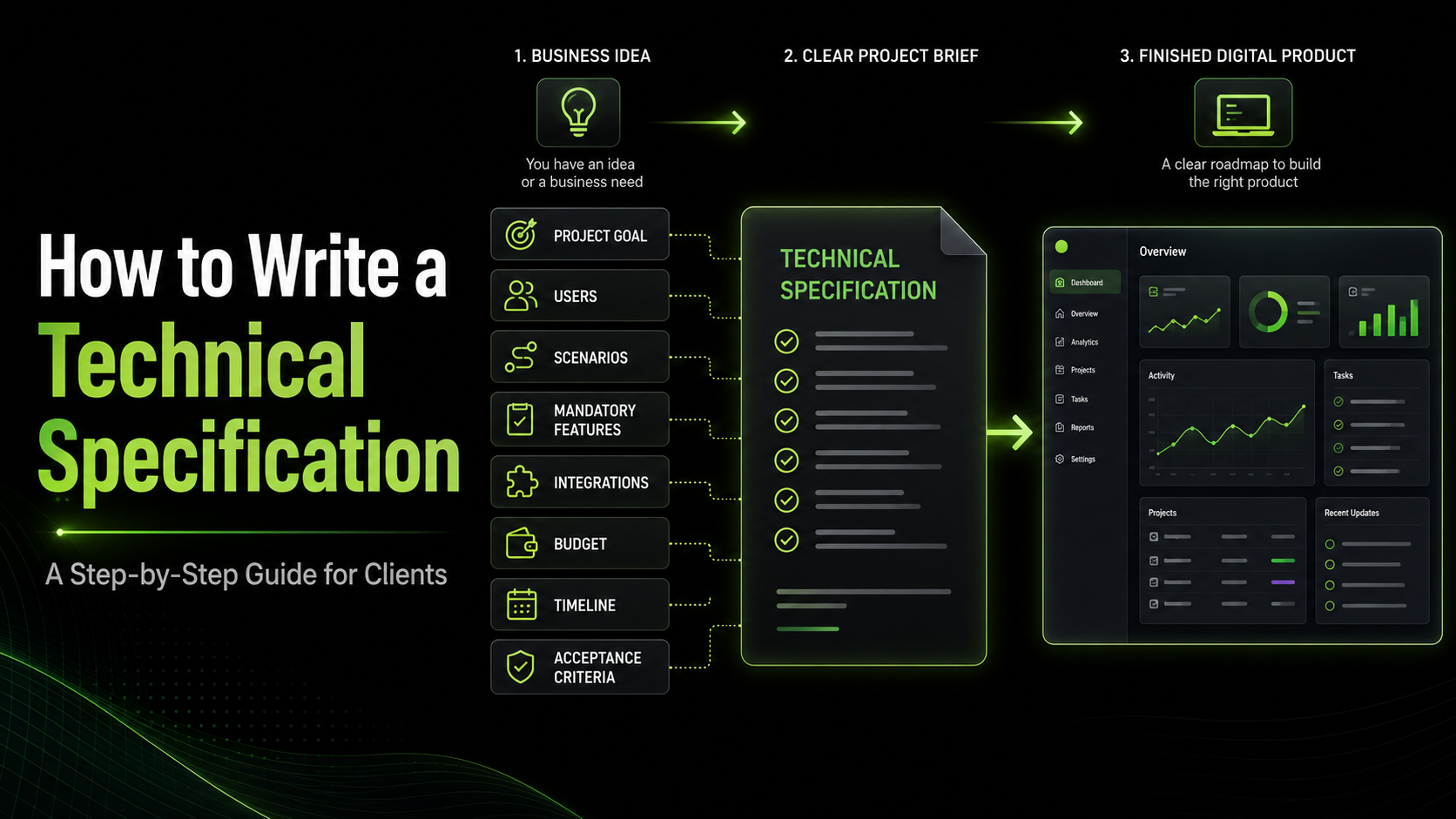
In brief
- • Clients do not need to choose technologies themselves to prepare a useful technical specification.
- • A strong specification describes the business problem, users, scenarios, and a verifiable result.
- • Features should be expressed through user actions rather than an abstract list of screens.
- • Mandatory first-release features should be separated from optional ideas and future stages.
- • Integrations, source materials, and the people responsible for providing them should be identified before development begins.
- • Every important feature needs an acceptance criterion that allows the result to be checked objectively.
- • A budget range is more useful than no budget, while the desired deadline should be connected to a real business reason.
- • Changes introduced after development begins should be recorded together with their effect on scope, cost, and timeline.
ContentsShow sections
A technical specification may look like a document that only a programmer can prepare. As a result, some clients postpone their projects, while others try to choose technologies, design database structures, and define software architecture without the necessary experience.
Clients do not need to become developers.
Their role is to explain the problem, describe the users, define what those users should be able to do, and state what result should be considered complete.
The developer translates those requirements into a technical solution.
A useful specification does not need to be one hundred pages long. A small website, Telegram bot, or MVP may only require several well-structured sections. The important goal is to ensure that the client and contractor understand the same scope.
What is a technical specification?
A technical specification is a structured description of a future product and its requirements.
It records:
the project goal;
target users;
primary scenarios;
mandatory features;
limitations;
integrations;
acceptance criteria;
timeline;
budget;
handover requirements.
The document is not supposed to predict every line of code. It answers a more practical question:
What result should the client receive, and how can both parties verify that it has been delivered?
Without this document, the same words may mean different things.
A client may request:
A user dashboard.
They may imagine a profile, order history, payments, notifications, and settings.
The developer may interpret it as one page containing a name and email address.
Both parties are discussing a dashboard, but their expected scope is completely different.
What should the client describe, and what should the developer decide?
The client understands the business, customers, and desired outcome. The developer understands technical implementation.
The client describes | The developer decides |
|---|---|
The problem being solved | The system architecture |
The target users | The appropriate technologies |
What users should be able to do | How data should be stored |
Which features are mandatory | How the application should be divided |
Known business restrictions | How security should be implemented |
How the result will be accepted | How deployment should work |
Clients usually do not need to write:
Use Next.js, PostgreSQL, Redis, and a microservice architecture.
It is more useful to write:
Users should be able to browse services, choose a date and time, pay for an appointment, and receive confirmation.
Technology requirements are appropriate when an organization already has mandatory infrastructure or when the new product must extend an existing system.
Step 1. Describe the problem and project goal
Do not begin with a list of pages and buttons.
Explain why the product is needed.
Weak description:
We need a five-page website with a dashboard and modern design.
Stronger description:
Customers currently book appointments through Telegram messages. A manager manually checks availability and confirms every request. We need a service that lets customers choose a service, available time, and receive confirmation without waiting for a manager.
The second version explains:
the current problem;
the existing process;
the desired improvement;
the primary user flow.
A useful project goal answers three questions:
What happens now?
What is inefficient or unreliable?
What should change after launch?
Example:
Requests currently arrive through several messengers and are sometimes lost. After launch, every request should appear in one administration panel where a manager can change its status and assign a responsible employee.
Step 2. Define users and roles
A product may serve several groups of people.
An appointment service may include:
a visitor;
a registered client;
an employee;
a manager;
an administrator.
Describe the available actions for each role.
Visitor
browses services;
views prices;
selects a specialist;
begins booking.
Client
signs in;
creates a booking;
reschedules or cancels it;
views booking history;
receives notifications.
Manager
views all bookings;
changes statuses;
contacts clients;
assigns employees.
Administrator
manages users;
adds services;
changes prices;
configures schedules;
views analytics.
This structure reveals access-control questions early.
Can a regular manager change prices? Should an employee see every client’s personal data? Can a client cancel five minutes before an appointment?
Step 3. Describe features through user flows
A feature list may remain too abstract.
For example:
registration;
dashboard;
payment;
notifications.
A developer sees module names but not exact behavior.
User flows provide more useful detail.
Registration
The user enters an email address, receives a one-time code, confirms the address, and enters the dashboard. If the code does not arrive, another one can be requested after 60 seconds.
Placing an order
The user adds a service to the cart, enters contact information, selects a payment method, and confirms the order. The order then appears in the user dashboard and administration panel.
Account recovery
The user enters an email address, receives a recovery link, and creates a new password. The link becomes invalid after use or expiration.
A strong scenario follows this pattern:
The user performs an action, the system responds in a defined way, and the result becomes available to the next participant or is stored.
Step 4. Prioritize features
One common reason budgets expand is that every idea is included in the first release.
Divide requirements into three groups.
Mandatory for the first release
Without these features, the product does not solve the primary problem.
For example:
registration;
service catalogue;
booking creation;
administration panel;
manager notifications.
Desirable
These features are useful, but the product can launch without them.
For example:
favorites;
promo codes;
advanced analytics;
several visual themes;
automated recommendations.
Future stage
Ideas that should be discussed after the first version has been tested.
For example:
mobile applications;
loyalty programs;
multiple CRM integrations;
complex partner roles;
a separate partner dashboard.
This division creates a realistic MVP and prevents unverified ideas from consuming the initial budget.
Step 5. List pages and sections
After describing goals and user flows, outline the interface structure.
For example:
home page;
service catalogue;
service page;
booking flow;
sign-in and registration;
user dashboard;
booking history;
administration panel;
settings;
privacy policy.
You do not need to design every button. Explain the purpose of each section and the information it should display.
Example:
The user dashboard shows upcoming and completed bookings. An upcoming booking displays the service, date, time, specialist, and status. A client may cancel no later than 24 hours before the appointment.
Step 6. Identify integrations
An integration connects the product with an external service.
Integrations can significantly affect scope, cost, and timeline.
Mention whether the product must connect to:
a payment provider;
Telegram;
a CRM;
email services;
telephony;
maps;
analytics;
inventory systems;
online cash registers;
external APIs;
spreadsheet imports;
document exports.
For each integration, clarify:
which service is used;
whether an account already exists;
whether documentation is available;
who provides access;
which data is transferred;
what should happen when the service fails.
Example:
After a new request is created, the system sends a message to the managers’ Telegram group. The message includes the client’s name, phone number, selected service, and a link to the request in the administration panel.
Step 7. Describe design requirements
“Modern and attractive” is not a measurable design requirement.
Different people interpret these words differently.
Provide:
a logo;
brand colors;
brand guidelines;
finished mockups;
links to relevant websites;
examples of specific interface sections;
examples of styles that should be avoided.
You may write:
We like the simple structure and large typography of website A. Website B has suitable card design. Avoid bright gradients, excessive animation, and visually crowded screens.
Clarify who is responsible for design:
the client supplies finished layouts;
the developer designs the interface;
a separate designer is involved;
an existing template is used.
Step 8. Record source materials
Development is often delayed by missing content rather than code.
Specify who will provide:
texts;
photographs;
product images;
the logo;
prices;
service lists;
legal documents;
translations;
domain access;
server access;
external service keys.
Example:
Material | Responsible party | Deadline |
|---|---|---|
Logo | Client | Before design begins |
Home page copy | Client | Before stage two |
Interface icons | Contractor | During design |
Privacy policy | Client | Before publication |
Telegram bot access | Client | Before integration setup |
This table makes dependencies visible.
Step 9. Add measurable general requirements
Some requirements apply to the complete product rather than one feature.
For example:
the website should work correctly on mobile devices;
the interface should support Russian and English;
the administration panel should be limited to authorized employees;
forms should be protected against automated spam;
users should not see other clients’ data;
the product should support current versions of major browsers;
a production build should pass before release;
application errors should be logged;
the database should be backed up.
Clients do not need to choose the implementation. They only need to describe the expected product property.
Step 10. Define acceptance criteria
An acceptance criterion explains how a feature will be verified.
Weak requirement:
Notifications should work correctly.
Verifiable requirement:
After a booking is created, the client receives an email containing the date, time, and service name. The manager receives a Telegram message within one minute.
Another example:
An administrator can create a service, enter its title, description, price, and image. After saving, the service appears in the public catalogue and can be selected during booking.
For each important feature, answer:
what action does the user perform;
what result appears;
where is it displayed;
who receives a notification;
what data is saved;
what happens when an error occurs.
Acceptance criteria protect both sides. The client receives an objective review method, while the developer understands the task boundary.
Step 11. Include a budget range
Some clients avoid sharing a budget because they believe every contractor will automatically quote the maximum amount.
In practice, no budget produces incomparable proposals.
One developer may estimate a minimal prototype. Another may include custom design, testing, analytics, and long-term support.
A range is more useful:
The first release budget is between RUB 150,000 and RUB 250,000. If the complete scope does not fit, propose a smaller MVP.
A budget range does not replace a detailed estimate. It defines the constraints within which a suitable solution should be found.
Step 12. Explain the desired deadline
Provide both the date and the reason.
Example:
A working version is required by October 1 because an advertising campaign begins on October 10.
Or:
A prototype is required within four weeks for an investor presentation. Public launch may be scheduled separately.
The developer can propose stages:
Analysis.
Prototype.
Main development.
Testing.
Release.
When the deadline is fixed, optional features can be moved to a later stage.
Step 13. Define the acceptance process
Before development begins, agree on:
who accepts the result;
where testing occurs;
how many days are available for feedback;
which defects are critical;
how many correction rounds are included;
when a stage is considered accepted;
when payment is released;
what counts as a new feature rather than a correction.
Example:
After completing a stage, the contractor provides a testing link. The client reviews the result within five business days and sends one consolidated list of comments. The contractor corrects deviations from the agreed specification. New features are estimated separately.
Step 14. Define project handover
The specification or agreement should state what the client receives after completion.
Usually this includes:
source code;
repository access;
server access;
database access;
the domain;
environment variable documentation;
launch instructions;
a list of connected services;
documentation;
a backup;
rights to created materials.
Whenever possible, primary accounts should belong to the client from the beginning, while the contractor receives limited access.
Step 15. Define how changes are handled
New ideas often appear after development begins.
The client may decide to add:
another user role;
a new payment method;
another language;
CRM integration;
historical data import.
These changes may affect architecture, cost, and timeline.
Agree on a rule:
New features and changes to agreed behavior are recorded separately. The contractor evaluates their impact on cost and timeline before implementation begins.
This rule separates defect correction from project expansion.
Copyable technical specification template
Use the following structure as a starting point.
1. Project name
A short working name.
2. Current situation
How is the task handled now, and what problems occur?
3. Project goal
What should change after launch?
4. Target audience
Who will use the product?
5. User roles
Which user types exist, and how do their permissions differ?
6. Primary user flows
What should each user be able to do?
7. Mandatory first-release features
Which functions are required to solve the core problem?
8. Optional features
Which functions are useful but can be postponed?
9. Excluded from the first release
Which ideas are deliberately outside the current scope?
10. Pages and sections
Which main screens are required?
11. Integrations
Which external services should be connected?
12. Design
Are there logos, brand guidelines, layouts, or references?
13. Source materials
Who provides copy, images, data, and account access?
14. General requirements
Mobile support, languages, security, browsers, and other constraints.
15. Acceptance criteria
How will every mandatory feature be verified?
16. Desired timeline
When are the prototype, first release, and public launch required?
17. Budget
What range is available?
18. Correction process
How are comments collected, and how many correction rounds are included?
19. Handover
Which source files, accounts, and instructions will the client receive?
20. Post-launch support
Is warranty support, defect correction, or future development required?
Example of a weak specification
We need a modern website for a beauty salon. It should include services, booking, a user dashboard, payments, and an administration panel. It should be completed quickly, look attractive, and be easy to use.
Problems:
the dashboard user is unclear;
the booking flow is undefined;
schedule behavior is unknown;
the payment method is not specified;
administrator capabilities are unclear;
there are no acceptance criteria;
content responsibility is unknown;
the project cannot be estimated objectively.
Example of an improved specification
The salon currently accepts bookings by phone and Telegram. A manager manually checks the schedule, which sometimes creates duplicate bookings.
We need a responsive web service where a client selects a service, specialist, available date, and time. After confirmation, the booking is stored in the system. The client receives an email, and the manager receives a Telegram message.
Registration is not required in the first release. The client enters a name, phone number, and email. The administrator manages services, employees, working hours, and unavailable dates. The manager views bookings and changes their status.
Online payments, loyalty programs, and mobile applications are excluded from the first release.
Acceptance criterion: a client can create a booking from a mobile device, the booking appears in the administration panel, the selected time becomes unavailable, and the manager receives a notification.
The budget is RUB 180,000 to RUB 250,000. A testing version is required within six weeks.
This description still does not define architecture, but it gives a developer enough information to ask focused questions and prepare an estimate.
Common specification mistakes
Listing screens without explaining the goal
Pages do not explain the business problem.
Choosing every technology yourself
The client may unintentionally force an unsuitable solution.
Failing to prioritize
Every idea is treated as mandatory, making the first release too large.
Using vague requirements
Words such as “fast,” “simple,” and “beautiful” require measurable clarification.
Hiding integrations
Unexpected payment or CRM integrations may significantly change the estimate.
Allowing unlimited corrections
The contractor does not know when the project is complete.
Having no responsible decision-maker
Several client representatives may provide contradictory feedback.
Ignoring handover requirements
After launch, the client discovers that the repository, server, or important accounts belong to the contractor.
How detailed should the specification be?
The required detail depends on project complexity.
Small landing page
A brief specification may include:
the goal;
section structure;
content;
design references;
form behavior;
mobile requirements;
analytics;
deadline.
Telegram bot or small service
The document should include:
roles;
scenarios;
states;
integrations;
administration features;
error handling;
acceptance criteria.
Complex platform
A separate analysis stage may be required:
stakeholder interviews;
process mapping;
prototypes;
data models;
permission specifications;
performance requirements;
security requirements;
integration planning;
release stages.
Clients do not need to prepare everything independently. Their initial document may become the foundation for a paid discovery stage with a developer or team.
How should a strong developer respond?
A professional contractor does not simply read the specification and immediately provide a price.
They:
ask clarifying questions;
identify contradictions;
clarify roles and flows;
explain risks;
suggest a smaller first release;
record assumptions;
explain the effect of integrations;
convert wishes into acceptance criteria;
divide the project into stages.
A contractor who agrees to everything without asking questions may not have studied the task deeply enough.
Checklist before publishing the specification
Before sending the document, verify:
Is the product problem clear?
Are users and roles listed?
Are the main scenarios described?
Are mandatory features identified?
Are future ideas separated?
Are integrations listed?
Is content responsibility clear?
Are acceptance criteria measurable?
Is a budget range included?
Is the desired deadline explained?
Is the correction process defined?
Are source code and account handover requirements recorded?
When most of these questions have clear answers, a developer can discuss the project productively.
Using the specification on VibeMarket
A prepared specification can serve as the foundation for a project request on VibeMarket.
Include:
the project goal;
primary features;
budget;
deadline;
mandatory integrations;
acceptance criteria;
available source materials.
Developers can review the requirements, ask questions, and propose an implementation approach.
A project request does not need to contain an enormous document. It should give contractors enough information to understand the first-release result and estimate the scope.
Final thoughts
Clients do not need programming knowledge to prepare a useful technical specification.
They need to describe:
the problem;
the goal;
the users;
the scenarios;
the mandatory features;
the integrations;
the restrictions;
the acceptance criteria;
the budget;
the timeline;
the handover process.
Do not attempt to design every technical detail yourself. A capable developer will propose an appropriate architecture, ask questions, and explain the risks.
The purpose of a specification is not to prevent every future change. It creates a shared understanding of the first product version and gives both parties a clear way to verify the result.