How Much Does Mobile App Development Cost in 2026? Freelancer Prices and Timelines
A practical guide to freelance mobile app development costs in 2026: MVPs, business apps, backend, payments, iOS, Android and cross-platform development.
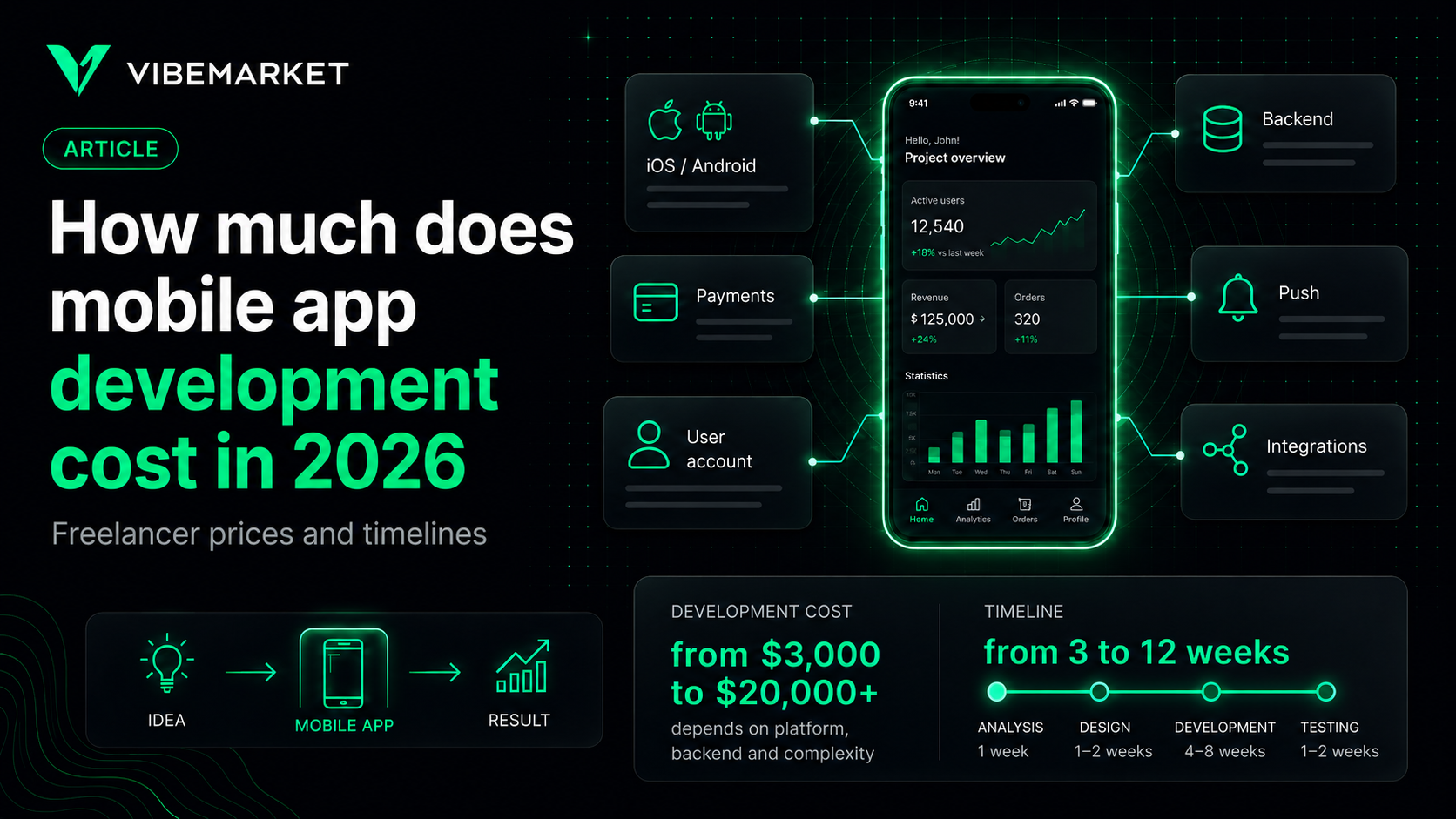
In brief
- • A focused cross-platform mobile app built by a freelancer can start at a few thousand dollars.
- • Backend services, payments, user roles and external integrations often affect cost more than the number of screens.
- • Cross-platform development can share much of the code between iOS and Android and is often practical for a first release.
- • Separate native iOS and Android applications usually require more development and testing.
- • Before comparing quotes, check whether backend, design, store submission, testing and post-launch support are included.
ContentsShow sections
How much does it cost to build a mobile application in 2026?
The answer can be $3,000, $10,000 or much more.
The difference is not simply caused by developer rates. The term “mobile app” can describe completely different products: a small application with a handful of screens, an online store, booking service, delivery platform, social product or complex business tool.
This is why estimating mobile development by screen count alone is rarely useful.
Backend requirements, user roles, payments, external integrations and the decision to support iOS, Android or both usually matter much more.
This guide focuses specifically on freelancers and small development teams. It covers practical planning ranges for mobile app development in 2026, what affects the budget and how to reduce first-release scope without removing the product's core value.
Important: these figures are planning ranges, not fixed VibeMarket prices or universal market averages. A developer can provide an actual quote only after reviewing the required product flows and features.
How much does freelance mobile app development cost in 2026?
For a focused first release built by an independent developer or small team, these ranges can be useful for initial planning:
Mobile app type | Typical budget | Typical timeline |
|---|---|---|
Simple cross-platform app | $3,000–$7,000 | 3–6 weeks |
App with user accounts and backend | $5,000–$10,000 | 4–8 weeks |
Business mobile app | $5,000–$12,000 | 4–9 weeks |
App with payments and integrations | $7,000–$18,000 | 5–10 weeks |
Multi-role service | $8,000–$20,000 | 6–12 weeks |
Complex mobile platform | $15,000+ | 2+ months |
These ranges assume that the first release is genuinely focused.
Separate native applications, sophisticated backend systems, real-time functionality, geolocation, financial workflows, many integrations or high-scale requirements can increase the budget significantly.
What are you actually paying for?
Users primarily see screens.
But the interface is only one part of a mobile product.
A real application may also require:
servers;
database;
API;
authentication;
permissions;
notifications;
file storage;
payments;
admin panel;
analytics;
external integrations;
app store preparation.
This is why two applications with ten screens can have dramatically different development costs.
Simple cross-platform app - $3,000–$7,000
One of the most affordable scenarios is a focused application with a limited number of features and relatively simple backend requirements.
The first release might contain:
onboarding;
authentication;
catalog;
item page;
favorites;
profile;
one or two forms;
simple notifications.
When cross-platform technology and proven services are used for standard functionality, a project like this can be planned roughly within $3,000–$7,000.
However, a product should not be judged only by how compact the interface looks.
Five screens in a financial application may require more engineering than twenty screens in a simple content catalog.
App with accounts and backend - $5,000–$10,000
A dedicated backend becomes necessary when the application stores and processes user-specific information.
This may include:
accounts;
orders;
documents;
subscriptions;
transaction history;
preferences;
personal data;
user-generated content.
Development now has at least two major parts: the mobile application and the server-side system.
An administration interface may also be needed so that the product owner can manage users, content and application data.
A focused application of this type can be planned around $5,000–$10,000 with a freelancer or small team.
Business mobile app - $5,000–$12,000
Not every mobile application is designed for the public.
Companies build custom apps for:
employees;
couriers;
technicians;
sales representatives;
warehouse teams;
service engineers;
managers.
A business application can look visually simple while containing substantial internal logic.
For example, a field employee may need to receive an assignment, open customer details, record arrival, upload photos, complete a report and change the job status.
The application may also synchronize with a CRM or other company systems.
A focused business mobile app can therefore fall around $5,000–$12,000.
App with payments - $7,000–$18,000
A payment flow may look like a few buttons to the user.
Behind those buttons is a complete transaction workflow.
The system may need to:
create an order;
calculate the amount;
initialize a payment;
send the user through checkout;
receive payment confirmation;
update the order;
handle failures;
process refunds when applicable;
handle repeated notifications;
keep mobile and server state synchronized.
Subscriptions, discounts, credits or multiple payment methods make the logic more complex.
A focused app with payments and several external integrations can therefore require around $7,000–$18,000.
Multi-role mobile service - $8,000–$20,000
Products connecting several groups of users usually require significantly more work.
Consider a delivery service.
It may contain:
customer;
courier;
operator;
administrator.
The customer creates an order and tracks its status.
The courier sees available deliveries and changes their status.
The operator manages the process.
The administrator controls the entire system.
This effectively creates several different interfaces connected to the same backend.
The same pattern appears in marketplaces, booking services, taxi applications and service platforms.
A focused first version of a multi-role product may therefore require roughly $8,000–$20,000.
iOS, Android or both?
One of the first product decisions is which platforms need to be supported.
The main options are:
iOS only;
Android only;
separate native applications for both;
one cross-platform application.
This decision affects both initial development and long-term maintenance.
Native mobile development
A native application is built specifically for one mobile platform.
This gives developers strong control over platform capabilities and behavior.
However, supporting both iOS and Android natively generally means maintaining two implementations of the product.
That increases development, testing and future maintenance work.
Cross-platform mobile development
Frameworks such as Flutter and React Native allow much of the application logic and interface code to be shared between iOS and Android.
This does not mean that every feature works identically on both platforms or that development automatically becomes twice as cheap.
Platform-specific work still exists.
However, for many business tools, booking services, catalogs, user portals and MVPs, cross-platform development can reduce duplication and make a first release more practical.
When one platform can be enough
If you know that most early users are concentrated on one platform, launching there first can reduce initial scope.
For example, you might release Android, validate demand and add iOS later.
Or the opposite.
This approach reduces the amount of work required before the first real users arrive.
For broad consumer products, however, excluding one major platform can also limit product validation.
What affects mobile development cost?
Backend
The backend stores data and implements business rules.
It may manage:
accounts;
orders;
payments;
statuses;
documents;
messages;
subscriptions;
notifications.
An application using an existing API is usually simpler than a project requiring an entire backend platform to be created from scratch.
User roles
One type of user is simpler than a product containing customers, sellers, employees, couriers and administrators.
Each role adds permissions and often separate interfaces.
Payments
Payments require server-side processing, status management, failure handling and security controls.
Recurring subscriptions add another layer of complexity.
Maps and geolocation
Maps are common in:
delivery;
taxi;
real estate;
travel;
logistics;
field services.
Displaying one location is relatively straightforward.
Route building, live tracking, delivery zones and real-time position updates require considerably more engineering.
Push notifications
A basic push notification is relatively simple.
A notification system that sends different messages according to order states, user actions and business rules requires backend logic and proper event handling.
Chat
A custom chat means message delivery, history, notification logic, statuses and potentially attachments.
If messaging is not the central product feature, a simpler communication method can sometimes be used during the first release.
File handling
Photos, videos and documents require uploading, storage, permissions and sometimes processing.
Media-heavy products also need to consider bandwidth and storage costs.
Administration
Most applications need a way to be managed.
Administrators may need to:
inspect users;
block accounts;
manage orders;
edit content;
handle complaints;
manage plans;
view statistics.
Admin functionality should therefore be included in the original scope rather than discovered at the end of development.
Mobile app design
Design cost depends on much more than screen count.
An internal business tool can often use an established component system.
A consumer-facing product may need custom branding, interactions, animation and a complete design system.
Before requesting development quotes, clarify whether:
designs already exist;
an existing style needs to be adapted;
standard UI is acceptable;
completely custom UX/UI is required.
This avoids the common situation where a client assumes design is included while the developer has estimated engineering only.
How long does mobile app development take?
A focused cross-platform first release can take roughly 3–6 weeks.
Applications with backend services, payments and several user roles are more likely to require six to twelve weeks.
Complex platforms can take considerably longer.
The number of developers is not the only factor.
When requirements continuously change, adding more people may simply increase coordination. Reducing the first-release scope is often a more effective way to launch sooner.
App store release
Development does not end when the installation package is created.
A release needs to be prepared for distribution.
This usually includes:
app name;
icon;
screenshots;
description;
privacy information;
release configuration;
final testing.
The project scope should clearly state who is responsible for preparing and submitting the release.
Costs after launch
Development is not necessarily the final expense.
A mobile product may continue paying for:
servers;
database;
file storage;
API domain;
transactional email;
SMS;
maps;
AI APIs;
analytics;
external services;
maintenance.
Installing the app on a user's phone does not eliminate backend infrastructure costs.
Before hiring a developer, ask:
“Which recurring services will I need to keep paying for after launch?”
Can a mobile app cost less than $1,000?
Sometimes.
Examples may include:
a very small prototype;
an app without a custom backend;
a WebView wrapper;
a simple companion application;
several screens using local data.
But a complete mobile product with user accounts, backend, payments, administration and support for both major platforms for $1,000 should raise additional questions.
Make sure that the client and developer are describing the same final product.
Why the cheapest quote can be misleading
Imagine receiving three quotes:
$3,000;
$7,000;
$12,000.
The first appears to be the obvious choice.
Then you discover that it excludes:
backend;
design;
admin interface;
store submission;
iOS testing;
several integrations.
The three proposals are therefore not actually comparable.
Compare equivalent scope, not headline prices.
What to check in a freelancer proposal
Before development begins, clarify:
Which features are included?
Which platforms are included?
Is the app native or cross-platform?
Is backend development included?
Who handles design?
Is an admin panel included?
Which integrations are included?
Who handles store submission?
What does testing cover?
Will you receive the source code?
How are post-release bugs handled?
What counts as additional paid scope?
This makes developer proposals much easier to compare.
Freelancer or agency?
For a focused mobile product, an experienced cross-platform freelancer or small team may be able to deliver most of the first release.
This can reduce management overhead and keep the budget relatively small.
An agency model becomes more useful when the project simultaneously requires:
product analysis;
UX/UI design;
iOS engineering;
Android engineering;
backend development;
QA;
DevOps;
project management.
The larger project costs more because more specialists are involved.
The choice should therefore depend on project scale rather than the labels “freelancer” and “agency.”
How to reduce mobile app development cost
1. Start with one core workflow
Do not turn the first release into a list of every feature discussed during product planning.
Choose the primary user journey and make it work completely.
2. Consider cross-platform development
When the product does not rely heavily on platform-specific functionality, sharing code between iOS and Android may reduce duplicated work.
3. Use proven services for standard infrastructure
Authentication, push notifications, analytics, file storage and payments often have established solutions.
Not every technical component needs to be built from scratch.
4. Keep rare operations manual initially
If an administrator performs a particular task twice per week, complex automation may not be necessary for the first release.
5. Move non-essential features to phase two
Additional filters, referral programs, advanced animations and secondary sections can be added after the primary product workflow has been validated.
How to prepare a mobile app for estimation
You do not need a hundred-page specification for an initial quote.
Start by answering these questions:
Who will use the application?
What is the primary action the user needs to complete?
Which user roles exist?
Are user accounts required?
Is a custom backend required?
Are payments required?
Which integrations are essential?
Is geolocation required?
Are push notifications required?
Is an admin interface required?
Do you need iOS and Android?
What can wait until phase two?
This is usually enough for an experienced developer to understand the general level of complexity and ask meaningful follow-up questions.
How to hire a mobile app developer through VibeMarket
VibeMarket has a dedicated mobile application development direction.
You can describe the product idea, main user workflow, target platforms, integrations and preferred timeline, then compare developer proposals.
Look beyond the final price and review:
relevant portfolio projects;
proposed technology;
first-release scope;
backend requirements;
release responsibilities;
timeline;
acceptance criteria.
VibeMarket supports two deal formats:
direct deal - 0% platform fee;
escrow-protected deal - 5% fee.
Before development begins, make sure the agreed scope clearly states which platforms and features are included in the price.
Final thoughts
A mobile application built by a freelancer in 2026 does not automatically require an agency-sized budget.
A focused cross-platform first release can be planned from around $3,000–$7,000, while applications with custom backend services, payments, multiple user roles and external integrations require larger budgets.
The number of screens and the words iOS or Android are not the largest cost drivers.
More important factors include:
business logic;
backend;
user roles;
payments;
integrations;
geolocation;
security requirements;
administration;
number of supported platforms.
Instead of asking only:
“How much does a mobile app cost?”
start with:
“What is the main action a user must be able to complete in the first release?”
Once that workflow is clear, it becomes much easier to define the necessary scope, compare developer quotes and avoid paying for features the product does not yet need.