Vibe Coder or Programmer: Who Should You Hire for a Project in 2026?
Learn how vibe coders differ from traditional programmers, which projects suit each workflow, and how to evaluate a contractor before work begins without treating AI use and engineering experience as opposites.
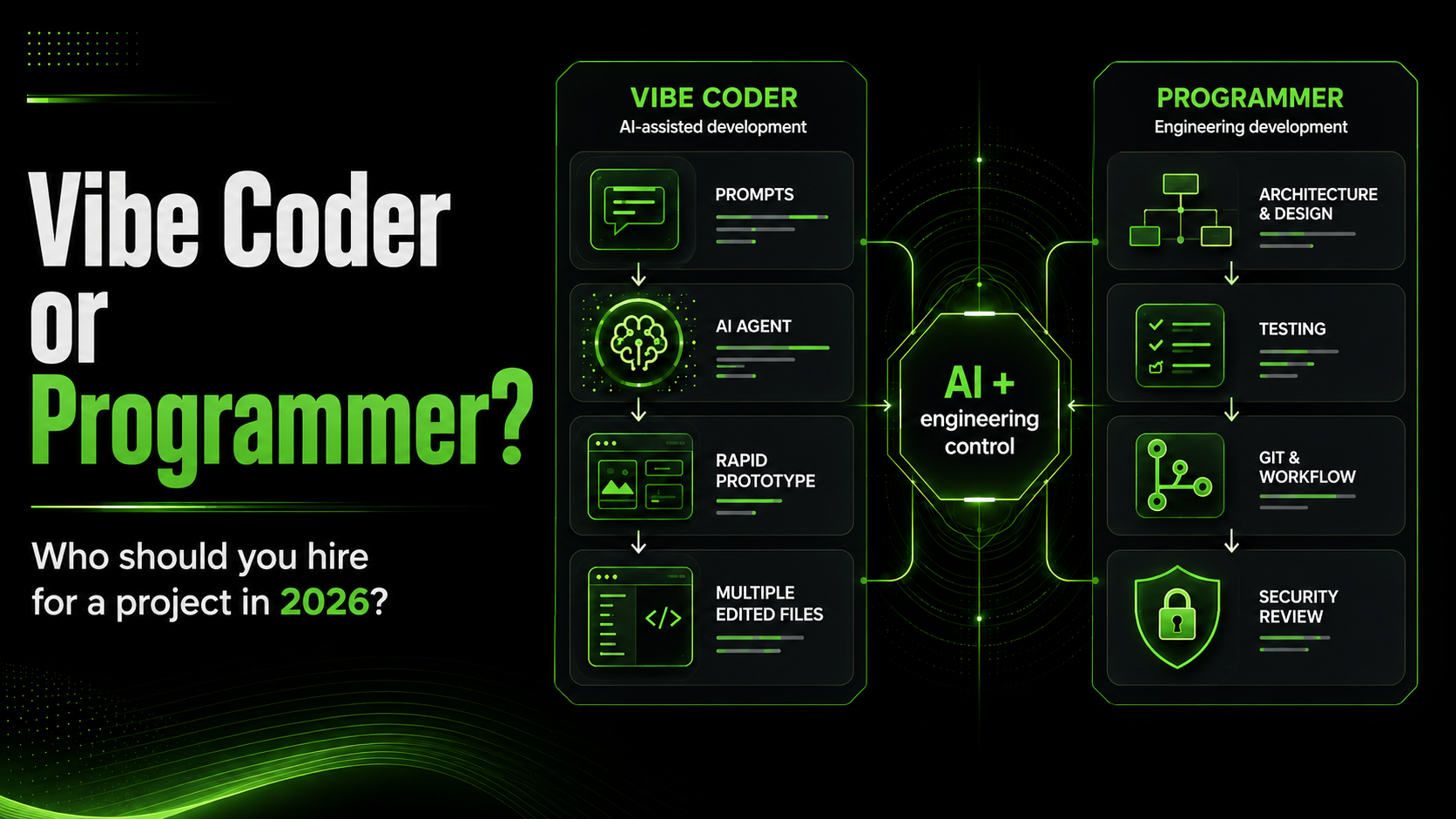
In brief
- • Vibe coders and programmers are not mutually exclusive roles because experienced developers can also rely heavily on AI.
- • The main difference is the workflow rather than the number of lines written manually.
- • A vibe coder may build an initial version quickly, but speed does not replace testing, security, or maintenance.
- • Complex systems, legacy code, and critical functionality require proven engineering experience.
- • Project cost depends on scope, complexity, and responsibility rather than the contractor’s preferred title.
- • Working products and the ability to explain technical decisions matter more than a list of tools.
- • Before development begins, both parties should agree on deliverables, acceptance criteria, access, source code ownership, and support.
- • For many projects, the strongest choice is an experienced developer who uses AI effectively.
ContentsShow sections
Vibe coder or programmer: this question is often presented as a choice between fast AI development and real engineering work.
In practice, the distinction is not that strict.
A professional programmer may use Cursor, Claude Code, Codex, and other AI tools every day. A vibe coder may understand architecture, databases, security, deployment, and long-term maintenance.
Clients should therefore avoid choosing a contractor by title alone. It is more useful to understand how the specialist works, what they have already launched, how they verify results, and whether they can support the product after release.
First, vibe coders and programmers are not always different people
A programmer creates software using programming languages, frameworks, databases, and other technical tools.
A vibe coder builds products with significant AI assistance. They describe the required outcome, receive a proposed implementation, guide the agent, review changes, and gradually turn the result into a working product.
These definitions can overlap.
An experienced developer may write part of the code manually and delegate another part to AI. A beginner vibe coder may gradually learn programming and become capable of understanding the systems they build.
The practical distinction is therefore not:
vibe coder versus programmer
It is closer to:
a contractor who understands the product and takes responsibility versus a contractor who accepts generated code without control
Responsibility for the final result should be the main selection criterion.
What is the practical difference?
Criterion | Vibe coder | Traditional programmer |
|---|---|---|
Main approach | Describes outcomes to AI and guides generation | Designs and implements the solution manually or with AI |
Initial version | May produce a prototype quickly | May spend more time on initial design |
Unfamiliar technologies | May rely on AI guidance | Usually relies more on personal experience |
Code understanding | Depends heavily on the individual | Deeper implementation knowledge is normally expected |
Architecture | May start from generated patterns and templates | More often designs the system from engineering experience |
Verification | Requires deliberate testing after generation | Also requires tests and code review |
Complex failures | May depend on AI to identify the cause | An experienced developer can investigate manually |
Maintenance | Possible when the contractor understands the system | Usually considered a normal part of professional development |
Best fit | Prototypes, MVPs, automation, and well-defined product tasks | Complex systems, critical logic, and long-term development |
This table describes common tendencies rather than every individual contractor.
A weak programmer can deliver an unstable product. A strong vibe coder can launch a reliable service with tests, documentation, and a maintainable structure.
How a vibe coder works
A vibe coding workflow is usually based on a sequence of conversations and controlled tasks.
Suppose a client needs an appointment booking service. The contractor may divide the work into stages:
Create the application structure.
Add a service catalogue.
Implement date and time selection.
Add authentication.
Configure the database.
Create an administration panel.
Add notifications.
Verify the mobile layout.
Deploy the project.
Test the main user flows.
AI helps create code, locate related files, explain errors, and suggest corrections.
A capable vibe coder does not send one large instruction asking AI to build the entire application. They manage the work in smaller stages, verify each result, and repeatedly compare the implementation with the client’s requirements.
An uncontrolled workflow looks different:
the contractor accepts large changes without review;
error messages are copied back into the chat without understanding;
random dependencies are installed;
no commits or recoverable versions are created;
permissions are not tested;
the contractor cannot explain how the product works;
problems cannot be fixed after deployment.
Using AI is not automatically an advantage or a disadvantage. The important question is whether the process remains controlled.
How a traditional programmer works
A traditional software developer usually begins by analyzing requirements and selecting a technical approach.
They determine:
the application structure;
the data model;
the authentication method;
module boundaries;
required integrations;
security requirements;
deployment strategy;
testing approach.
The developer then writes the code manually or uses AI as an additional tool.
The main value of an experienced programmer is not typing speed. It is the ability to understand the consequences of technical decisions.
For example, a developer should consider:
what happens when several users act at the same time;
how data can be restored after a failure;
who can access the administration panel;
how the system will be updated;
how the architecture can change in the future;
whether another specialist can continue the work.
These questions become increasingly important when a prototype becomes a real product.
Who is faster?
A vibe coder may produce an initial version faster, especially when the task follows a common pattern:
a landing page;
a Telegram bot;
a user dashboard;
a catalogue;
an appointment form;
a small automation;
an internal business tool;
an MVP for testing an idea.
AI can quickly generate a basic structure, interface, and repetitive implementation.
However, the speed of the first generation is not the same as the speed of delivering a production-ready product.
Time may later be spent on:
correcting inconsistent architecture;
removing unnecessary dependencies;
finding hidden defects;
restoring accidentally broken logic;
rebuilding authentication;
configuring deployment;
fixing security problems.
An experienced programmer may begin more slowly because they design the foundation first. This may reduce expensive changes later.
Clients should therefore ask more than:
When will I see the first version?
They should also ask:
What will remain to be verified after the first version, and when will the product be ready for real users?
Who costs less?
It is not accurate to assume that a vibe coder is always cheaper than a programmer.
Project cost depends on:
feature scope;
business logic;
user roles;
design;
integrations;
authentication;
payments;
security requirements;
mobile support;
administration tools;
testing;
deployment;
ongoing support.
AI may reduce manual work. However, a capable contractor is paid for a finished result and responsibility rather than the number of lines typed.
If a low-cost implementation must later be rewritten, the original saving disappears.
Proposals should be compared by what they include:
requirements analysis;
design;
implementation;
testing;
corrections;
server configuration;
source code transfer;
documentation;
post-launch support.
Which projects suit a vibe coder?
A competent vibe coder can be a good choice for products with clear user flows and a limited first stage.
Landing pages and company websites
AI can help produce page structure, responsive layouts, forms, and basic administration features.
The contractor should still verify:
mobile rendering;
form delivery;
loading performance;
SEO fields;
analytics;
spam protection;
production deployment.
Telegram bots and Mini Apps
A vibe coder may implement menus, requests, notifications, catalogues, basic authentication, and integrations.
Complexity increases when the product includes:
payments;
several user roles;
personal data;
a complex database;
CRM integration;
high traffic.
Internal business tools
Examples include:
document generators;
request tracking;
analytics dashboards;
spreadsheet processing;
notification automation;
small CRM modules.
These products may suit rapid AI-assisted development when the number of users is limited and the requirements are clearly defined.
MVPs
A vibe coder can help test a product idea quickly and determine whether users need its primary features.
An MVP should define:
the hypothesis being tested;
mandatory features;
excluded features;
the data that should be collected;
what happens after the idea is validated.
When is an experienced programmer especially important?
Some projects require deep engineering experience regardless of whether AI is used.
Existing large products
Changing an existing codebase is more difficult than generating a new prototype.
The contractor needs to understand:
the current architecture;
hidden dependencies;
previous technical decisions;
old migrations;
integrations;
infrastructure limits;
the effect on existing users.
AI can help explore a repository, but responsibility for safe changes remains with the specialist.
Payment systems
Payment logic requires careful handling of:
transaction states;
repeated requests;
webhooks;
refunds;
permissions;
secret keys;
logs;
error processing.
A contractor should have relevant experience and understand the consequences of failure.
Products with sensitive data
Authentication, data storage, and access control require deliberate review.
The greater the potential damage from a defect, the more important proven experience and an additional security review become.
High-traffic products
Products designed for many users require planning for:
performance;
caching;
queues;
monitoring;
fault tolerance;
scaling;
backups.
A rapidly generated first version may not address these requirements.
Long-term development
Products expected to evolve for years require:
understandable architecture;
consistent coding standards;
documentation;
tests;
easy onboarding for new specialists;
controlled dependency updates.
Clients should choose a contractor or team capable of both launching the first version and maintaining the system.
The strongest option is often in the middle
Clients do not need to choose between someone who refuses to use AI and someone who depends on it completely.
A strong modern developer may:
use AI to explore a project;
accelerate repetitive implementation;
generate test scenarios;
investigate errors;
prepare documentation;
automate routine work;
independently verify architecture and security;
remain responsible for the final result.
This approach provides the speed of AI without transferring responsibility to the model.
A more useful question is:
How well does the contractor combine AI speed with engineering review?
How to evaluate a contractor before work begins
A professional title does not prove practical ability. Clients should look for evidence.
Review working products
A screenshot only shows appearance.
Ask for:
a working product link;
a demonstration video;
a description of the original task;
an explanation of the contractor’s role;
a list of implemented features;
deployment information;
examples of challenges and corrections.
The specialist should understand their own product and explain it clearly.
Clarify personal contribution
A project may involve a designer, developer, product owner, and other contractors.
Ask:
what the candidate completed personally;
which decisions they made;
who configured the server;
who designed the database;
who fixed problems after release;
whether the candidate can continue support.
Ask for an approach to your project
A full architecture is not required before an agreement.
However, the contractor should explain:
where they would begin;
how the project would be divided;
which requirements need clarification;
where they see major risks;
what belongs in the first version;
how the result would be verified.
Discuss testing
Ask how the specialist verifies:
main user flows;
mobile rendering;
forms;
authentication;
permissions;
integrations;
error handling;
production builds.
“AI will test everything” is not a sufficient answer.
Begin with a limited stage
For a larger project, the first paid stage may be:
a requirements audit;
a prototype;
a technical plan;
one independent module;
an integration experiment;
a limited implementation stage.
This allows the client to evaluate communication, quality, and reliability without committing the full budget.
Questions to ask during the first meeting
Which similar products have you already launched?
What was your personal contribution?
Which AI tools do you use and for what?
How do you review AI-generated code?
How do you use Git and recover previous versions?
Which tests would you plan for this product?
How will source code and access be transferred?
Who will own the repository, domain, and server?
Which corrections are included after delivery?
Can you support the product after release?
Which risks do you already see?
What can be removed from the first version to test the idea sooner?
A capable contractor does not need an immediate answer to every technical uncertainty. They should identify unknowns honestly and suggest a way to investigate them.
Red flags
Be cautious when a contractor:
promises to build any product in a few days;
gives a final price without asking questions;
refuses to show working projects;
cannot explain their own implementation;
does not use version control;
avoids discussing testing;
stores secret keys directly in the code;
requests primary passwords for every service;
does not define the first release scope;
treats unlimited changes as free;
avoids discussing repository and access transfer;
refuses to discuss post-launch support;
explains failures by saying that AI wrote the code.
These warning signs matter regardless of whether the person calls themselves a vibe coder or a programmer.
How to describe a project and receive relevant proposals
Even a strong specialist cannot accurately estimate a project described as:
Build a modern service similar to a popular application.
A useful request should include:
the product goal;
user types;
primary scenarios;
mandatory features;
optional features;
integrations;
available materials;
acceptance criteria;
target timeline;
budget range;
source code transfer requirements;
support expectations.
Clear requirements make different proposals easier to compare.
How to compare candidates
Do not evaluate price and response speed alone.
Criterion | What to check |
|---|---|
Experience | Relevant working products |
Understanding | Quality of questions |
Approach | Ability to divide work into stages |
Verification | Clear testing and acceptance process |
Transparency | Understandable scope and pricing |
Responsibility | Willingness to correct implementation defects |
Handover | Source code, access, and instructions |
Support | Ability to continue after release |
The cheapest candidate may become expensive after a rewrite. The most technical candidate may propose an unnecessarily complex solution.
The goal is to find a balance between experience, process clarity, and project fit.
Who should you choose?
Choose a competent vibe coder when:
you need to test an idea quickly;
the first version has limited scope;
user flows are clear;
the project can be divided into stages;
the contractor shows working products;
they verify the code and take responsibility for deployment;
critical risks remain controlled.
Choose an experienced programmer or team when:
the product contains complex business logic;
an existing system must be developed further;
the project handles payments or sensitive data;
high traffic is expected;
a defect may cause significant damage;
the product is intended for long-term development;
deep infrastructure integration is required.
Choose a developer with engineering experience and strong AI skills when you want speed, control, and maintainability together.
How VibeMarket helps clients compare contractors
On VibeMarket, a client can describe a project, specify the budget, deadline, and acceptance criteria, and compare developer proposals.
Profiles should be evaluated through working projects, the proposed approach, and the specialist’s ability to explain their work rather than only a list of technologies.
For a broader explanation of the role, read “Who Are Vibe Coders”.
After preparing the requirements, you can post a project on VibeMarket and compare contractor approaches.
Final verdict
Vibe coders and programmers are not opposites.
Vibe coding describes a workflow involving AI. Programming describes a broader collection of technical skills and practices. One specialist may combine both.
Clients should focus on practical questions:
can the contractor show a working result;
do they understand the requirements;
can they review AI-generated code;
can they deploy the product;
will they transfer source code and access;
will they take responsibility for defects;
can they support the system after release?
A capable contractor uses the tools that help solve the problem. Responsibility for the final product always remains with a person.