How to Write a Task for a Vibe Coder: A Practical Brief
A practical brief template for context, boundaries, acceptance criteria, access, tests, and the expected output from a vibe coder.
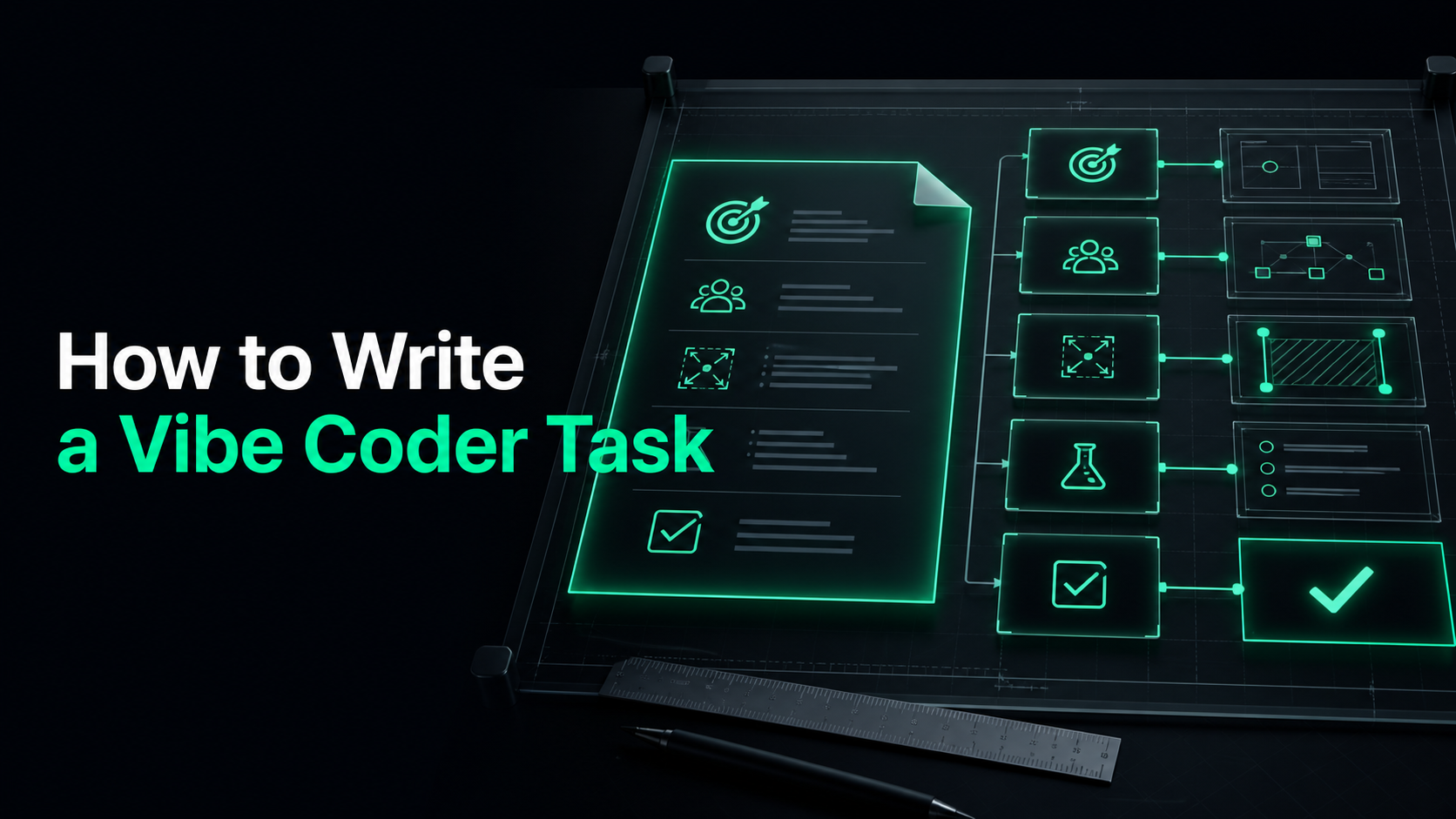
In brief
- • A vibe coder brief should describe outcomes and constraints, not only technology.
- • Context prevents an AI-oriented developer from inventing business rules.
- • Boundaries and prohibitions protect the project from unnecessary changes.
- • Acceptance criteria must be testable by another person.
- • The best first task is a short brief plus one vertical flow.
ContentsShow sections
A vibe coder can start from a single sentence, but a fast start does not guarantee a correct result. When business rules are missing, the developer and the AI begin inventing them. That creates extra features, wrong permissions, and polished interfaces that do not solve the original problem.
The template below can be copied into a request. It differs from a traditional technical specification by making AI boundaries, verification, and the expected explanation part of the brief.
1. Goal
Write one sentence describing who needs what outcome. For example: “A manager should see new leads and assign an owner within two minutes.” Do not start with “build a React app”—that is a solution, not a goal.
2. Context
- who the users are;
- how the process works today;
- what already exists: website, CRM, API, design, or database;
- constraints around budget, timing, and access.
3. Primary flow
Describe the journey step by step: entry, action, outcome, next step. Add empty state, error, repeated submission, and cancellation behavior. One testable flow is more useful than ten broad wishes.
4. Boundaries and prohibitions
State what must not change: payment provider, existing data model, design system, permissions, public API, or production environment. List what is out of scope for now: mobile apps, complex roles, localisation, or automatic email sending.
5. Acceptance criteria
- a new user can complete the flow;
- errors show a clear message;
- a repeated request does not create a duplicate;
- data is visible only to the allowed role;
- the change can be tested and rolled back;
- the developer hands over a link, source, and short instructions.
6. Working with AI
Do not only ask the developer to “use AI.” Ask them to explain what changed: files, decisions, checks, and areas that still need human attention. For agentic work, use a separate branch, test data, and no default production access.
Copyable template
Goal: …
User: …
Context: …
Primary flow: …
Required: …
Out of scope: …
Constraints: …
Acceptance criteria: …
Deliverables: link, source, tests, instructions.
Add the first milestone budget and deadline. For help posting the task, use a VibeMarket project request. The broader technical specification guide is also useful, while this article focuses on an AI-oriented developer.
Turning the brief into a budget
Once the scope is explicit, the quote becomes easier to check: a simple landing page — $300–$1,200, a Telegram bot — $250–$2,000, and a small working MVP — $2,000–$6,000. List integrations, roles, acceptance, and support separately because they are the parts most likely to change the estimate.
See the full vibe coder rates and cost guide →
Bottom line
A good vibe coder task does not predict every file. It defines the goal, context, boundaries, and the evidence that proves the result works.