How Much Does Ecommerce Development Cost in 2026: Catalogue, Store, or Marketplace?
A practical guide to freelancer ecommerce development prices, project complexity, integrations, additional costs, and the difference between an online store and a marketplace.
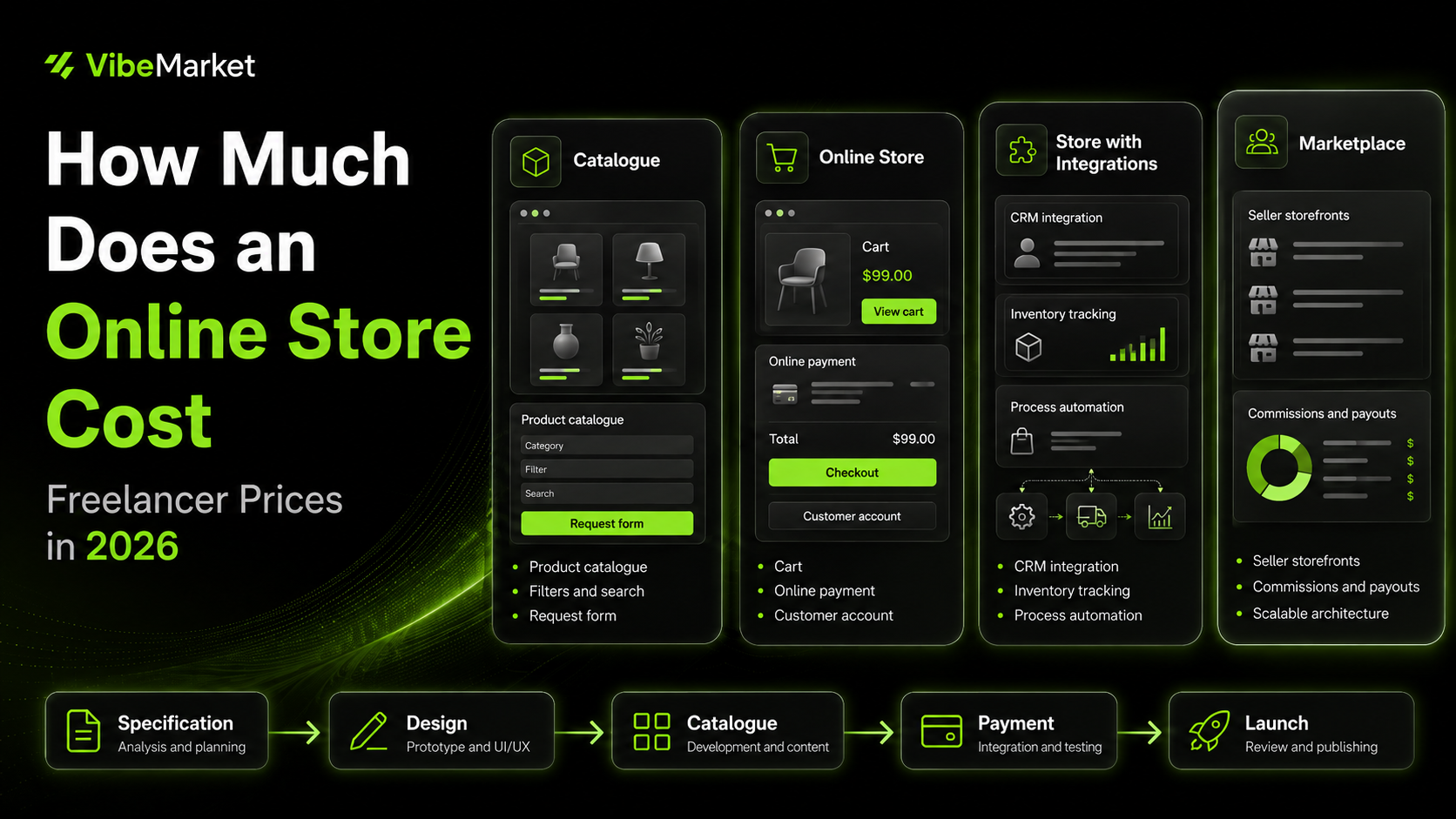
In brief
- • Ecommerce development cost depends on business processes rather than the number of pages alone.
- • A product catalogue, a standard online store, and a multi-vendor marketplace are fundamentally different products.
- • Public freelancer offers suggest a realistic range of 300-700$ for a simple template-based launch.
- • A standard online store with a catalogue, cart, payment, and administration panel commonly requires 600-1500$
- • A custom store with individual design, customer accounts, and integrations may cost 1500-3500$.
- • A limited marketplace MVP should normally be budgeted from 3500$, while complex platforms with sellers, commissions, and payouts may start from 7000$.
- • A low advertised starting price may exclude design, content, payments, delivery, integrations, testing, and deployment.
- • Shopping carts, payments, delivery, inventory, and administration tools require complete backend logic.
- • SEO, mobile usability, security, and performance should be considered during initial product design.
- • Freelancer proposals should be compared by scope, stages, acceptance criteria, and source code handover rather than price alone.
ContentsShow sections
The request to “build an online store” may describe completely different products.
One business may need a small catalogue containing twenty products and a contact form. Another may require a shopping cart, online payments, delivery, customer accounts, and an administration panel. A third may use the words “online store” while actually describing a multi-vendor marketplace.
These products cannot have the same development cost.
An honest estimate therefore begins with business processes, functionality, and complexity rather than one universal price.
This article reviews publicly advertised freelancer rates in the Russian-speaking market as of August 2, 2026, the components of ecommerce development, additional expenses, and the questions clients should ask before work begins.
Quick answer: freelancer ecommerce development prices
Public freelancer offers support the following budget guidelines.
Project type | Realistic freelancer budget | Approximate timeline |
|---|---|---|
Catalogue or simple template store | 300-700$ | 1-3 weeks |
Standard online store | 600-1500$ | 2-6 weeks |
Custom store with integrations | 1500-3500$ | 1.5-4 months |
Limited marketplace MVP | 3500-7000$ | 2-5 months |
Complex marketplace | From 7000$ | From 4 months |
These figures are not official statistical averages or guaranteed final prices.
They are practical budget corridors derived from public freelancer offers. The final estimate depends on features, design, platform, integrations, and the quality of the project specification.
Offers below 300$ exist, but they often represent:
a template-based launch;
a very small catalogue;
limited design;
no complex integrations;
a website builder;
configuration of an existing product;
basic setup without custom development;
a starting price with paid extras.
Clients should compare the included scope rather than the headline price alone.
Four different products may be called an online store
1. Product catalogue with request forms
This is the simplest option.
Users can:
browse products;
open categories;
view product pages;
review specifications;
submit a request;
contact a manager.
A complete cart and automated payment flow may not be included.
Orders may be handled manually through:
phone calls;
email;
Telegram;
CRM;
an administration panel.
This format can suit businesses where:
products require consultation;
pricing is calculated individually;
the catalogue is small;
online payment is not yet required;
demand needs to be tested quickly.
A realistic freelancer budget is approximately 300-700$.
The lower end usually assumes a template or website builder. Individual design, complex filters, and large product imports increase the cost.
2. Standard online store
A standard store allows customers to complete the entire journey from product discovery to order placement.
It usually includes:
a catalogue;
categories;
product pages;
search;
filters;
shopping cart;
checkout;
online payments;
delivery;
notifications;
an administration panel;
mobile support;
basic SEO preparation.
A realistic freelancer budget is RUB 600-1500$.
The lower end may be possible when:
an established CMS is used;
design is template-based;
the catalogue is small;
one payment method is connected;
delivery follows a standard model;
no complex accounting integration is required.
The estimate moves towards the upper end when the project requires:
individual design;
complex catalogue structure;
product variants;
customer accounts;
product imports;
several delivery methods;
more advanced administration tools.
3. Custom ecommerce system
Custom development is appropriate when an existing platform cannot support the company’s processes or creates excessive restrictions.
The project may include:
individual design;
non-standard catalogue logic;
complex product variations;
customer accounts;
order history;
loyalty programs;
personalized prices;
CRM integration;
accounting or inventory integration;
several employee roles;
automated documents;
multiple warehouses;
advanced analytics;
a custom administration panel.
A realistic freelancer budget is 1500-3500$.
The price may exceed this range when the project requires complex migration, high traffic, mobile applications, or several external systems.
4. Multi-vendor marketplace
A marketplace differs from a regular online store because products are listed by several independent sellers.
The system may require:
seller registration;
seller dashboards;
moderation;
several stores in one catalogue;
commissions;
payouts;
financial reporting;
order splitting;
returns;
disputes;
ratings;
documents;
seller restrictions;
access management;
customer support.
A limited marketplace MVP can reasonably be discussed within 3500-7000$.
The first version will not contain every function available on a major marketplace. It may include:
seller registration;
a catalogue;
product pages;
one order flow;
one payment integration;
a simple commission model;
a basic administration panel;
some manually processed operations.
A complex marketplace with automated payouts, several commission models, returns, disputes, and financial reporting commonly requires a budget from 7000$.
A marketplace should not be estimated as a regular store with one additional seller page.
What determines ecommerce development cost?
Discovery and specification
Before development begins, the project needs to define:
the product type;
target users;
user roles;
the buyer journey;
catalogue structure;
payment methods;
delivery;
administration processes;
integrations;
acceptance criteria.
When requirements are unclear, a freelancer may include discovery in the total estimate or propose a separate paid stage.
Strong discovery reduces expensive redesign later.
Prototype
A prototype demonstrates page structure and user flows without final visual design.
It may help approve:
navigation;
catalogue structure;
product pages;
cart behavior;
checkout;
customer accounts;
administration scenarios.
A small store may not require a separate prototyping stage. A more complex product usually benefits from it.
Design
A project may use:
an existing theme;
an adapted template;
custom design;
layouts supplied by the client.
A ready-made solution is usually faster and less expensive.
Individual design increases the budget but allows better control over:
branding;
audience needs;
complex scenarios;
mobile layouts;
catalogue behavior.
Clients should confirm whether design is included in the freelancer’s proposal.
Some offers cover programming only and require finished layouts from the client.
Frontend
The frontend is the part customers use directly.
It includes:
home page;
catalogue;
product page;
cart;
checkout;
customer account;
information pages;
responsive layouts;
loading and error states.
Cost depends on unique components and states rather than page count alone.
A single filter may require:
parameter controls;
URL synchronization;
backend requests;
stored selections;
mobile behavior;
empty-result handling.
Backend
The backend manages internal logic.
It processes:
users;
products;
prices;
inventory;
carts;
orders;
payments;
delivery;
notifications;
permissions;
integrations;
administrative actions.
A simple interface can hide a large amount of backend work.
Database
The database may store:
products;
categories;
attributes;
variants;
inventory;
users;
addresses;
carts;
orders;
payments;
promo codes;
reviews;
change history.
More complex catalogues and permission systems require more data modelling.
Administration panel
Most stores require administration tools.
Employees may need to:
add products;
update prices;
upload images;
manage categories;
review orders;
change statuses;
create promo codes;
process returns;
manage customers;
view reports;
control employee permissions.
An established CMS may already provide some of these capabilities.
Custom development requires the administration panel to be built or integrated separately.
Catalogue complexity
A catalogue is more than a list of products.
The project should define:
product count;
categories;
nested categories;
attributes;
variants;
sizes;
colours;
inventory;
pricing levels;
discounts;
bundles;
filters;
search;
sorting;
import;
export.
A store with twenty similar products and a catalogue with fifty thousand spare parts need different architectures.
Product page
A simple product page may contain:
title;
price;
description;
several images;
purchase button.
A complex product page may include:
variants;
inventory;
video;
documentation;
specifications;
reviews;
questions;
comparisons;
recommendations;
accessories;
customer-group pricing;
delivery estimates;
stock notifications.
Every additional function affects timeline and cost.
Shopping cart
The cart needs to manage:
adding products;
quantity changes;
removal;
inventory validation;
price changes;
promo codes;
discounts;
delivery;
persistence;
repeated requests;
errors.
When inventory or pricing changes, the customer should receive updated information before payment.
Checkout
During checkout, customers may provide:
name;
phone;
email;
address;
delivery method;
pickup point;
comments;
payment method;
company information;
consent to legal documents.
The project should define whether an account is mandatory or guest checkout is supported.
Payment integration
Payment integration includes more than opening a payment page.
The system should:
Create an order.
Create a payment.
Save a pending status.
Receive backend confirmation.
Prevent duplicate processing.
Update the order.
Send notifications.
Handle cancellation or errors.
Support refunds where required.
An order should not be marked as paid only because the customer returned from a bank page.
The freelancer proposal should clarify whether it includes:
webhook configuration;
a testing environment;
transaction logs;
error handling;
refunds;
documentation.
Delivery
The simplest delivery model may provide:
fixed pricing;
store pickup;
free delivery above a threshold.
More complex options may include:
address-based pricing;
pickup-point maps;
several delivery providers;
regional restrictions;
multiple warehouses;
split shipments;
different delivery times;
product weight and dimensions;
tracking.
Delivery integrations may significantly increase development cost.
Customer account
The account may include:
profile;
addresses;
order history;
statuses;
repeat orders;
returns;
loyalty points;
documents;
subscriptions;
support requests.
When an account is not essential to the first release, it can be postponed.
Integrations
External systems often determine the real project cost.
A store may connect to:
CRM;
accounting systems;
inventory services;
ERP;
online cash register;
delivery providers;
payment providers;
email;
SMS;
Telegram;
analytics;
advertising systems;
loyalty platforms;
supplier catalogues.
Even a ready-made connector needs to be configured and tested against the business process.
Product import
Existing data may be stored in:
Excel;
CSV;
accounting systems;
another CMS;
CRM;
supplier databases;
several inconsistent tables.
Migration may require:
cleaning data;
removing duplicates;
category mapping;
image processing;
attribute conversion;
price verification;
inventory validation.
Import should normally be estimated separately.
Ecommerce SEO
SEO requirements should be included before implementation.
Core elements include:
understandable URLs;
unique titles;
metadata;
indexable categories;
sitemap.xml;
robots.txt;
canonical tags;
structured product data;
removed-product handling;
duplicate prevention;
performance;
mobile usability.
Filters require special attention.
When every parameter combination creates an indexable page, search engines may discover thousands of low-value duplicates.
Performance
An online store may contain:
many images;
large catalogues;
search;
filters;
dynamic pricing;
recommendations;
analytics;
external widgets.
The developer may need to control:
image optimization;
catalogue loading;
database queries;
caching;
server rendering;
JavaScript size;
mobile performance;
slow-network behavior.
Fixing performance after launch may be more expensive than designing it correctly.
Security
A store needs to protect:
administration tools;
customer accounts;
personal data;
payment statuses;
APIs;
forms;
file uploads;
secret keys;
activity history.
Minimum protections may include:
role separation;
secure authentication;
rate limiting;
form protection;
logging;
backups;
dependency updates;
secure secret storage.
Website builder, CMS, or custom development
Website builder
Suitable when:
the catalogue is small;
processes are standard;
fast launch matters;
integrations are simple;
platform restrictions are acceptable.
Advantages:
lower starting cost;
ready-made interface;
faster launch;
managed infrastructure.
Limitations:
platform dependency;
recurring subscription;
design restrictions;
difficult custom features;
possible export restrictions.
CMS
Suitable for standard ecommerce when appropriate modules already exist.
Advantages:
ready administration panel;
many extensions;
familiar management interface;
faster launch.
Risks:
plugin conflicts;
paid modules;
difficult updates;
performance problems;
dependence on theme quality.
Custom development
Suitable when:
business processes are non-standard;
custom logic is required;
integrations are complex;
long-term development is expected;
existing platforms create limitations.
Advantages:
control over logic;
flexibility;
scaling options;
no unnecessary modules.
Limitations:
larger budget;
longer timeline;
ongoing maintenance;
higher contractor requirements.
Expected scope at different budgets
300-700$
A project may include:
ready-made template;
small catalogue;
basic categories;
product pages;
cart;
order form;
simple payment setup;
responsive layout;
basic administration;
publication.
Often excluded:
individual design;
complex filters;
customer accounts;
accounting integration;
large data migration;
advanced SEO;
complex delivery;
long-term support.
600-1500$
A project may include:
complete catalogue;
search and filters;
cart;
checkout;
payment;
delivery;
administration panel;
mobile version;
basic SEO;
analytics;
launch.
The client should separately confirm:
design;
product count;
import;
refunds;
customer accounts;
integrations;
content population.
1500-3500$
This range may include:
individual interface;
complex catalogue;
customer accounts;
employee roles;
several integrations;
promo codes;
loyalty features;
documents;
advanced administration;
data import;
testing;
deployment;
documentation.
The price may increase because of:
multiple warehouses;
personalized prices;
high traffic;
complex migration;
several languages;
mobile applications.
3500-7000$
This range may support a limited marketplace MVP:
customer registration;
seller registration;
seller dashboard;
catalogue;
product pages;
orders;
basic commission;
payment;
moderation;
administration panel;
notifications;
source code and deployment.
Some operations may remain manual during the first release.
From 7000$
A larger budget is required for:
automated payouts;
several commission models;
split payments;
returns;
disputes;
ratings;
financial reporting;
documents;
several seller types;
advanced moderation;
high traffic;
mobile applications;
developed customer support.
This is not an upper price limit.
Why one offer costs 150$ and another 2000$
The difference does not always mean that one freelancer is overcharging.
The included work may be completely different.
Question | Proposal A | Proposal B |
|---|---|---|
Design | Existing template | Individual design |
Catalogue | Up to 20 products | Large import |
Payments | Excluded | Integration and testing |
Delivery | Fixed price | Delivery provider integration |
Administration | Basic CMS tools | Custom administration |
Testing | Basic | User flows and permissions |
SEO | Metadata | Complete technical preparation |
Handover | Platform access | Repository and infrastructure |
Support | None | Included after release |
Clients need to compare equivalent results.
Additional expenses
The development price may exclude:
domain;
server;
website-builder subscription;
CMS licence;
paid modules;
design;
copywriting;
product images;
product entry;
email service;
SMS;
online cash register;
payment-provider fees;
delivery services;
technical support.
Ask the freelancer to separate:
One-time development cost.
Mandatory external expenses.
Recurring expenses.
Optional functions.
Post-launch maintenance.
Preparing the project for an estimate
Provide the freelancer with the following information.
Product type
catalogue;
online store;
marketplace.
Catalogue
product count;
category count;
attributes;
variants;
inventory;
expected growth.
Users
customer;
manager;
administrator;
seller;
support operator.
Payments
bank cards;
instant payment methods;
payment on delivery;
business invoices;
subscriptions;
instalments.
Delivery
courier;
pickup;
pickup points;
shipping providers;
internal delivery.
Integrations
accounting;
CRM;
inventory;
cash register;
analytics;
suppliers;
Telegram;
email.
Content
who provides product data;
who writes descriptions;
who prepares images;
whether an old catalogue needs migration.
Design
template;
references;
brand identity;
finished layouts;
custom design.
Timeline and budget
Provide a budget range and explain why the launch date matters.
Copyable ecommerce brief
Product type
Catalogue, regular online store, or marketplace.
Goal
Which business problem should the project solve?
Products
How many products, categories, and variants are required initially?
Customers
Who will use the store?
Main scenarios
What should happen from first visit to order delivery?
Payments
Which methods are required?
Delivery
Which models should be supported?
Customer account
Which data and actions should be available?
Administration panel
Which information should employees manage?
Integrations
Which external systems should be connected?
Existing data
Should products, customers, and orders be migrated?
Design
Are layouts, brand guidelines, or references available?
SEO
Which categories and search pages are important?
Budget
Which range is available?
Timeline
When is the result required and why?
Acceptance criteria
Which scenarios must work before launch?
Comparing freelancer proposals
Create a simple comparison table.
Criterion | Freelancer 1 | Freelancer 2 | Freelancer 3 |
|---|---|---|---|
Total price | |||
Design | |||
Catalogue | |||
Payments | |||
Delivery | |||
Administration | |||
Integrations | |||
SEO | |||
Testing | |||
Deployment | |||
Source code | |||
Support | |||
Timeline |
This makes pricing differences easier to understand.
Questions to ask a freelancer
Which platform will be used?
Why does it fit the project?
What is included in the price?
Is design included?
How many products will be added?
Is data import included?
Who connects the payment provider?
How is payment confirmed?
Is delivery integration included?
What can administrators manage?
Who owns the repository?
Where will the project be hosted?
How are backups handled?
Which tests are performed?
What counts as a correction or a new feature?
How much post-launch support is included?
Which external expenses are required?
Can another developer continue the project?
Warning signs
Be cautious when a freelancer:
provides an exact price without questions;
promises a complex store in several days;
does not ask about product count;
ignores backend payment confirmation;
treats a store and marketplace as equivalent;
does not document scope;
does not use Git;
provides no testing version;
ignores backups;
refuses source code handover;
uses only personal infrastructure accounts;
does not explain support costs;
guarantees sales growth.
Dividing development into stages
Stage 1. Discovery
requirements;
roles;
scenarios;
integrations;
technical plan.
Stage 2. Prototype
structure;
catalogue;
product page;
cart;
checkout.
Stage 3. Design
visual system;
main pages;
mobile layouts.
Stage 4. Catalogue
products;
categories;
search;
filters;
import.
Stage 5. Orders
cart;
checkout;
statuses;
notifications.
Stage 6. Payments and delivery
testing environment;
webhooks;
error handling;
integrations.
Stage 7. Administration
products;
orders;
users;
roles;
content.
Stage 8. Testing
main scenarios;
mobile devices;
permissions;
error cases;
performance.
Stage 9. Launch
server;
domain;
analytics;
backups;
access handover.
Stage 10. Maintenance
defect correction;
monitoring;
updates;
new features.
Milestone-based payments reduce risk for both sides.
Posting an ecommerce project on VibeMarket
Clients can use VibeMarket to request:
a product catalogue;
an online store;
a marketplace;
an administration panel;
integrations;
a mobile application;
support for an existing store.
The request should include:
product type;
product count;
mandatory functions;
payment methods;
delivery;
integrations;
budget;
timeline;
acceptance criteria.
A detailed and honest description makes freelancer proposals easier to compare.
You may also find “How to Write a Technical Specification for a Developer” useful.
Final thoughts
In 2026, freelancer ecommerce development may cost from several tens of thousands of rubles to one million or more.
Realistic guidelines are:
300-700$ for a simple catalogue or template store;
600-1500$ for a standard online store;
1500-3500$ for a custom store with integrations;
3500-7000$ for a limited marketplace MVP;
from 7000$ for a complex commerce platform.
The cheapest offer is not always the most economical result.
Before choosing a freelancer, compare:
scope;
functions;
design;
integrations;
testing;
source code handover;
maintenance;
external expenses.
Define the business processes and first product version before comparing platforms, proposals, and budgets.