What Projects Can You Safely Entrust to a Vibe Coder?
A practical risk matrix for deciding which products a vibe coder can build independently and where senior engineering review is essential.
In brief
- • Vibe coders are a good fit for bounded tasks with clear outcomes and a manageable cost of failure.
- • Risk depends less on screen count than on data, money, permissions, and failure consequences.
- • An MVP can work with a vibe coder when milestones, review, and server-side checks are in place.
- • Payments, security, personal data, and high traffic require additional experience.
- • Create a risk matrix before hiring, not only a feature list.
ContentsShow sections
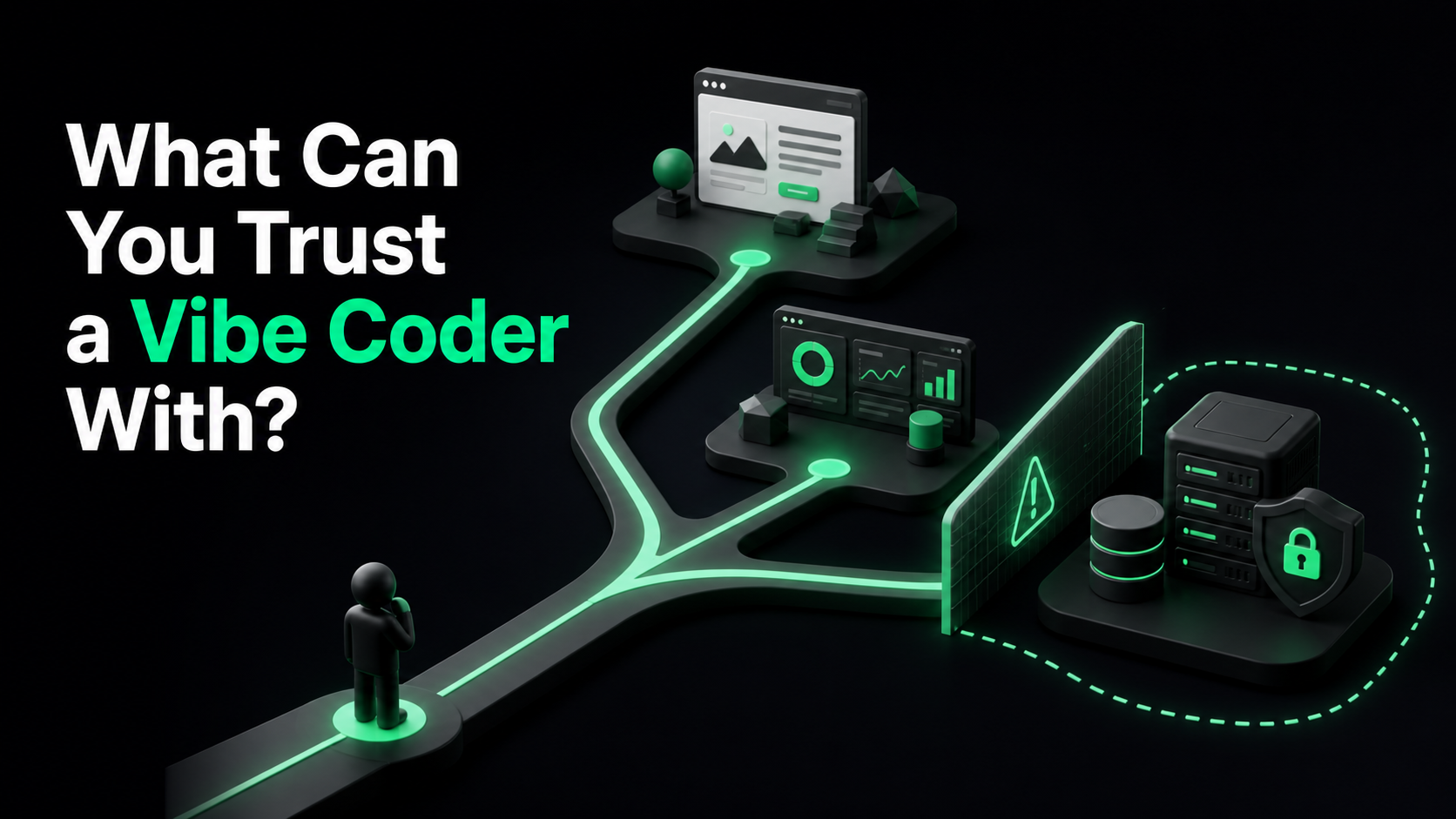
A vibe coder can build a landing page, an internal tool, an MVP, or one part of a larger product. The real question is not the job title but the cost of failure. A broken demo is one kind of risk. A payment error, exposed medical record, or lost customer database is another.
Green zone: a good starting point
- landing and marketing pages;
- prototype user flows;
- internal dashboards without sensitive data;
- simple forms, catalogues, or calculators;
- repeatable automation with an easy rollback;
- focused MVPs for testing a hypothesis.
Repository access, a test environment, and acceptance criteria are still required. Low risk does not mean no review.
Yellow zone: add oversight
This includes role-based SaaS products, customer portals, Telegram Mini Apps with payments, CRM integrations, data imports, and services that must run continuously. A vibe coder can implement a large portion of the work when a technical plan, review, and security check are part of the process.
Red zone: do not delegate without experienced engineering
- payment accounting and financial logic;
- systems holding large volumes of personal or medical data;
- financial, legal, or critical infrastructure;
- complex concurrency and high-traffic workloads;
- production database migrations without recovery planning;
- systems where failure can stop the business or create major losses.
AI can accelerate pieces of these projects, but it does not replace architecture ownership, threat modeling, or operations.
A simple decision matrix
| Question | If yes | Add |
|---|---|---|
| Is there one clear primary flow? | A focused first milestone may fit | Acceptance criteria |
| Are money or personal data involved? | Risk is higher | Server-side checks and review |
| Must it run 24/7? | Operations matter | Monitoring, logs, backups |
| Is rollback difficult? | Move carefully | Staging and recovery plan |
How to delegate safely
- Start with one vertical user flow.
- Give access to a test environment only.
- Request a plan, risks, and verification method.
- Demonstrate each milestone.
- Accept security and data handling separately from the UI.
Use the VibeMarket services catalogue and vibe coder profiles. For role boundaries, see the comparison of a vibe coder and a programmer.
Budget by risk level
In the green zone, a simple landing page is often $300–$1,200. A yellow-zone product with data and integrations may be $2,000–$10,000, while a red-zone SaaS, payment, or high-responsibility product starts around $6,000 and can go higher. This is not a price ceiling; it connects the budget to the cost of failure.
See the full vibe coder rates and cost guide →
Bottom line
You can trust a vibe coder with a task when you can limit it, verify it, and survive a possible mistake. The higher the cost of failure, the less acceptable “just trust the AI” becomes.