How Much Does It Cost to Take an AI-Built MVP to Launch?
What makes up the cost of taking an existing MVP to launch: diagnosis, fixes, operations, acceptance, handover, and recurring costs.
In brief
- • A single price before diagnosis does not show the real scope.
- • Separate audit, blocking fixes, launch, handover, and after-launch costs.
- • A new-MVP market range cannot be copied into a budget for existing code.
ContentsShow sections
After code generation, a separate phase begins
“The MVP is already built” does not answer how much it will cost to launch. Between a demo and a working product there may be requirements review, critical fixes, environment setup, data protection, deployment, observability, and handover.
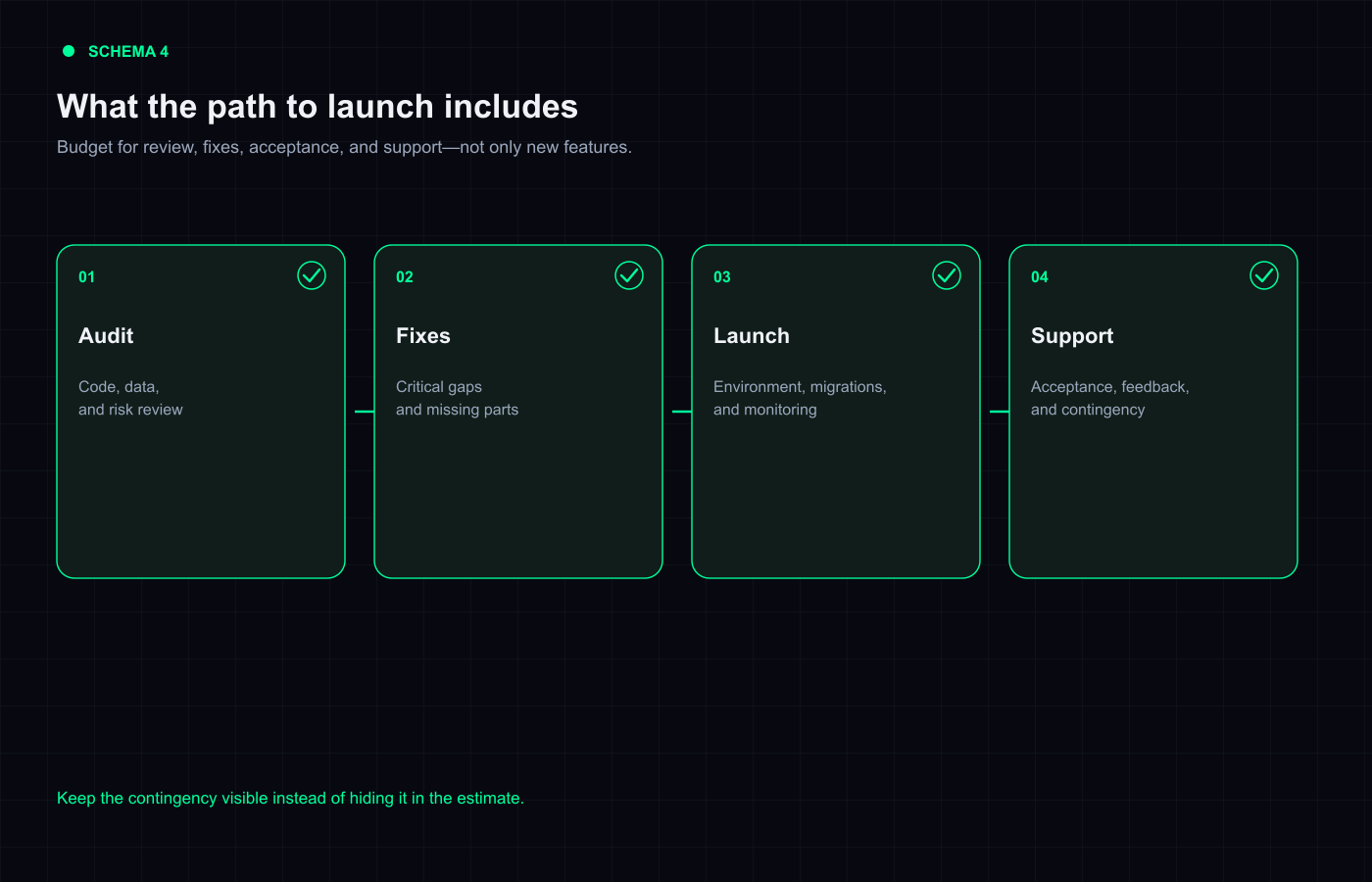
A responsible answer therefore starts without a single number. First find out what remains and how well it can be measured. The cost of finishing a reproducible, testable project is different from the cost of rescuing code that only works on its author’s computer.
What makes up the launch budget?
| Stage | What it includes | Why it changes the estimate |
|---|---|---|
| Diagnosis | Startup, architecture, workflows, and risk review | Without it, nobody knows what to fix or whether the current result is trustworthy |
| Corrections | Critical bugs, permissions, data, integrations, and retries | Problem count and failure cost matter more than screen count |
| Operational readiness | Environments, build, domain, logs, backups, and rollback | A demo may work without any of these |
| Acceptance and handover | Test scenarios, documentation, access, and setup instructions | Without handover, the product depends on its original author |
| After-launch costs | Hosting, database, APIs, email, storage, and support | These are recurring costs, not one-time development |
Why an MVP description is not enough for a fair price
Two projects with the same five screens may have very different costs. One may be a form with local data. The other may include roles, payments, status history, personal data, webhooks, and an obligation to stay available.
An estimate needs at least repository access, startup instructions, a list of workflows, environment details, and a record of what has already been tested. If a contractor names a final total before a short diagnosis, ask what assumptions it includes and what would be treated as extra work.
Three estimation scenarios
The project is reproducible and the main flows work
In this case, you can estimate the remaining issues, strengthen tests, configure the live environment, and prepare the release. The main risk is paying for a full rebuild of something that can already be used safely.
The project starts, but its behavior is unpredictable
Begin with an audit and a risk map. Fixing features one at a time without understanding the architecture can break authorization, migrations, or integrations. Split the budget into diagnosis, blocking fixes, and the next stage.
The code does not start or only exists on the original author’s machine
Here you are paying for more than bug fixes. The team must recover the environment, obtain service access, understand the data, and decide what can be kept. Rewriting a limited section may be cheaper, but that should be an audit conclusion, not the first suggestion.
How to get a comparable estimate
Ask each contractor to break the proposal into the same lines:
- audit and risk list;
- mandatory pre-launch fixes;
- testing and acceptance criteria;
- Preview and Production setup;
- migration and backup recovery;
- documentation and access handover;
- post-launch support;
- external costs paid separately.
Each line needs an output, timeline, assumptions, and boundaries. “We will fix everything” is not comparable. A good estimate can contain unknowns, but it explains how they will be resolved.
How to estimate without inventing a tariff
Before an audit, use a formula rather than a random number:
Launch budget = diagnosis + blocking fixes + operational readiness + acceptance and handover + external costs + reserve for unknown risks.
A reserve should not hide the absence of a plan. It depends on the quality of the starting project and the amount of unknown work. Critical systems may need separate lines for security review, load testing, and recovery planning.
Public articles about building a new MVP can provide broad market context, but they cannot be copied into the budget for existing code. VibeMarket’s MVP cost guide separates general guidance from a project-specific estimate; the final scope still depends on features, data, integrations, and responsibility.
Questions to ask before agreeing
- What will you inspect before giving a final price?
- Which problems block launch and which can wait?
- Who owns the hosting, database, domain, and external services?
- Does the work include data recovery and rollback testing?
- How will the result be accepted?
- What happens if a bug appears after launch?
If the project already exists, begin with a separate diagnosis or support task instead of “finish the MVP.” You can use VibeMarket’s project support service and attach acceptance criteria.
The short answer
The cost of taking an MVP to launch depends less on how many lines AI generated and more on how much uncertainty remains before safe operation. Record the current state first, then separate mandatory work from recurring costs. That produces a quote you can verify, not just a number that sounds confident.
Discussion
Comments
No comments yet. Be the first to share your experience.
Sign in to join the discussion →