When Vibe Coding Is the Wrong Fit: Projects Where AI Adds More Risk Than Value
How to recognise projects where vibe coding cannot be the only development method: money, critical data, irreversible actions, availability, and ownership.
In brief
- • The key test is failure cost and verifiability.
- • Payments, critical data, irreversible actions, and always-on systems require engineering ownership.
- • AI can still help with isolated tasks, tests, and documentation.
ContentsShow sections
The question is not whether the team uses AI
Vibe coding is a poor fit not because AI appears in the project. The risk appears when the result cannot be properly checked, a failure is hard to roll back, and nobody owns the architecture or the consequences of launch.
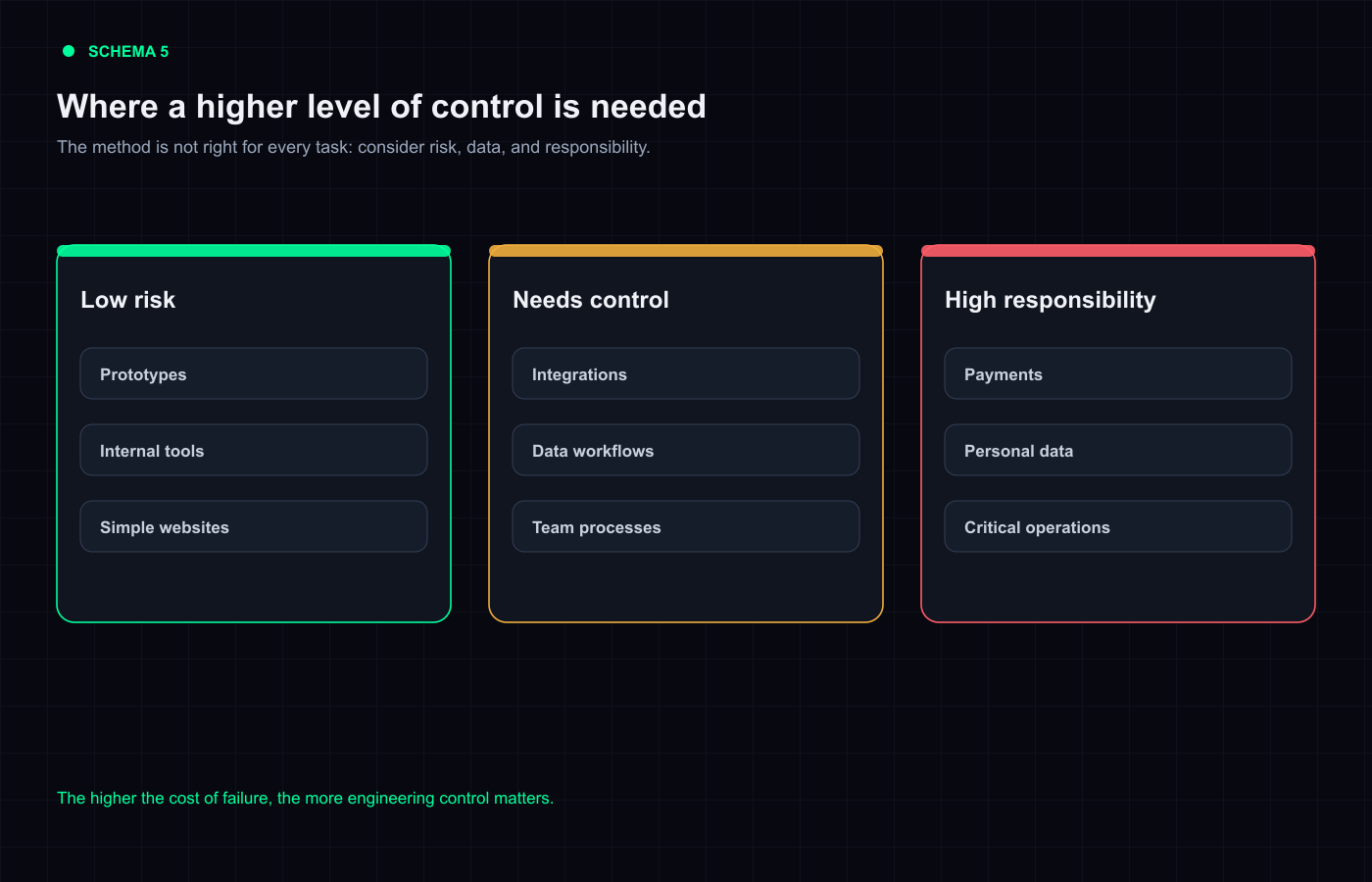
The same tool may suit a landing page and be unsuitable as the only way to run a payment core. The real choice is not “AI or traditional development,” but the level of responsibility, control, and failure cost you need.
1. A mistake immediately affects money
Payments, refunds, balances, fees, and reconciliation require exact rules, idempotency, and a clear transaction history. The interface may have only a few buttons, but an error in server logic creates a real financial dispute.
AI can help with isolated tests, screens, and supporting functions. Money movement, retries, refund permissions, and reconciliation need engineering review.
2. Data cannot be lost or exposed
Medical, financial, personal, and commercially sensitive data require limited access, logs, safe storage, and a clear deletion policy. A filter or permission bug can show data to the wrong person.
If the team cannot explain where data is stored, who can see it, how access is revoked, and how the database is restored, vibe coding should not be the project’s only control.
3. The product must stay available
An internal experiment and a service people rely on every hour are different jobs. Continuous operation needs monitoring, backups, alerts, recovery planning, update control, and a person who can respond to an incident.
An AI agent can help prepare configuration or diagnose an error. It does not replace on-call responsibility or the decision about when a live system can be changed safely.
4. A failure is hard to reverse
Do not hand production migrations, financial record changes, large data deletion, or irreversible actions to fast iterations without safeguards. The harder the rollback, the more important a copy, a test environment, and staged review become.
If a project cannot be safely stopped or restored, code generation speed is no longer its main advantage.
5. Requirements are unclear and keep changing
AI responds well to a specific task with a clear result. It is not a substitute for product decisions when the team has not agreed on the user, the rule, or the definition of success.
In that situation, fast code can increase change cost: the interface, data, and permissions get rebuilt after every clarification. Define the workflow and acceptance criteria first, then build.
6. The domain needs specialist expertise
In regulated fields, features are not enough. Storage, logging, access, documentation, and decision traceability may all matter. A general agent answer is not evidence of compliance.
Bring in someone who knows the domain before the architecture hardens. Fixing a compliance gap at the end costs more than stating the constraint at the beginning.
7. Nobody owns the outcome
The most worrying setup is “let AI build it,” while the contractor cannot explain the decisions and nobody owns incidents or change requests after launch. A tool can accelerate work; it cannot own the product.
Before starting, name the person who approves criteria, accepts risk, controls access, and decides what reaches Production.
A decision matrix
| Condition | What to do |
|---|---|
| Limited workflow, low failure cost, clear acceptance | Start with vibe coding and short verification stages |
| Roles, data, integrations, or always-on operation | Add a technical plan, review, and a separate security check |
| Money, critical data, irreversible actions, or high responsibility | Use an experienced engineer; AI remains a tool inside a controlled process |
How to use AI when full vibe coding is not a fit
You do not have to reject AI completely. Limit its role to tests, documentation, small isolated changes, duplicate-code search, and log analysis. Move changes through a branch, review, tests, and Preview.
If a project already exists, start with a diagnosis and one safe improvement. Describe the current problem and result through VibeMarket’s project support service. For a new product, state the constraints in the project request.
The short answer
Vibe coding is not a fit as the only source of decisions when the result is hard to verify, the failure is hard to reverse, or no person is accountable. At low risk, it shortens the path to a first version. At high risk, it should sit inside an engineering process rather than replace it.
Discussion
Comments
No comments yet. Be the first to share your experience.
Sign in to join the discussion →