How Vibe Coders Make Money: Freelance, Products, Teams
Compare freelance projects, independent products, and team roles, including what each path requires and where its risks lie.
In brief
- • Earning depends on the value of the task and responsibility for the result, not on code generation itself.
- • Freelance work, independent products, and team roles require different skills and carry different risks.
- • Agree on scope, acceptance criteria, access, and support before estimating work.
ContentsShow sections
Vibe coding does not create income by itself. Money comes from solving someone's problem and delivering something they can use. A useful way to group the options is three paths: client projects, a product of your own, or a role on a team. Each path has different costs, risks, and skill requirements; a quick prototype is not automatically a paid result.
Current as of September 25, 2026.
What clients pay for
Clients usually need an outcome, not code for its own sake: less manual work, a way to collect requests, a catalogue, a test of an idea, or a new customer flow. AI can help prepare part of the solution faster, but the value depends on whether the problem is solved and the result can be used.
Before estimating the work, agree on the deliverable: what will be handed over, which data is involved, who provides copy and access, what counts as done, and who supports it afterward. Without those boundaries, a small task can turn into open-ended work that continues "until it feels perfect."
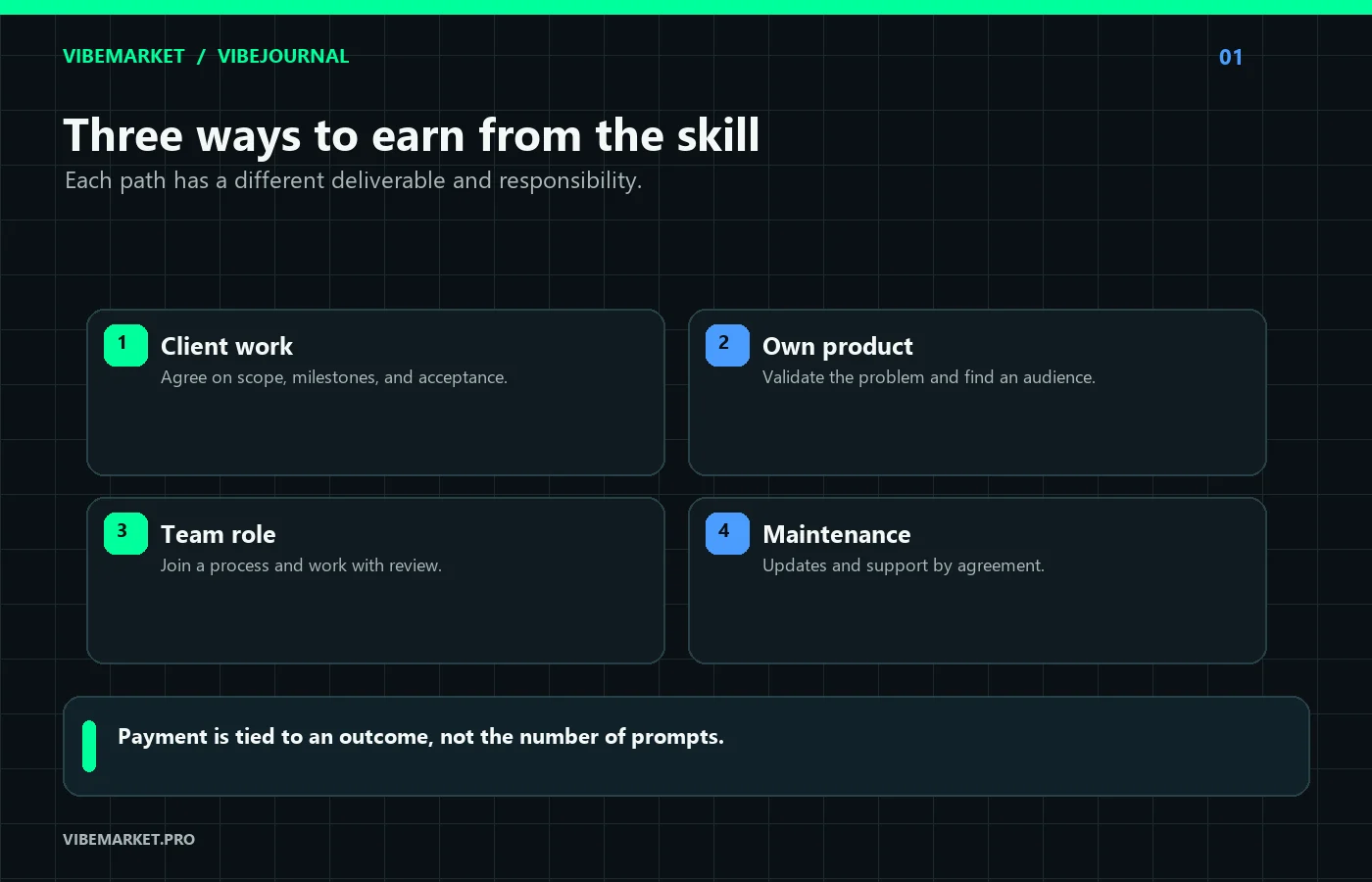
Three ways to earn
| Path | What people pay for | Why it appeals | Main constraint |
|---|---|---|---|
| Freelance work and client MVPs | A prototype, form, automation, or specific user flow | You can take scoped work and get feedback from a real client | You need to manage scope, revisions, and handover |
| Your own micro-product | Access, a subscription, a licence, or a paid feature | You control the direction and can sell one solution repeatedly | Income is uncertain; users, support, and distribution still matter |
| A role on a team | Product contribution and reliable delivery | You have colleagues for review, product context, and shared responsibility | You must follow processes, accept review, and understand existing code |
These are different paths, not interchangeable income promises. Freelancing may lead to a first payment sooner, but it takes communication and expectation management. An independent product gives you more control, but development is only one part of the job. A team can help you learn, while interviews still assess more than your ability to prompt an AI tool.
Related work can include automation setup, prototype audits, documentation, and maintenance. Package these as separate services with a clear outcome rather than an unlimited offer to "help with AI."
Do not sell what is not ready
A demo can look convincing while failing to save data, handle concurrent actions, or recover from an outage. Separate these points in a proposal:
- what already works: a specific flow you can demonstrate;
- what you will deliver: an outcome with acceptance criteria;
- what is out of scope: new sections, integrations, or ongoing support;
- what release requires: a domain, accounts, hosting, and a security review;
- who owns follow-up work: updates, support requests, and backups.
Price depends on scope, uncertainty, timing, and responsibility. Do not set it by the number of prompts or files. First understand the request, state your assumptions, and agree on milestones. If security, payments, or personal data are outside your experience, include a specialist review as a separate step.
Turn the skill into paid work
If you are learning, start with a small service for a specific audience: a page with a form, an internal request list, or a prototype that can be tested. Pick something you can explain in one sentence and show in a short demo. Gather feedback, fix one real obstacle, and record what you handled yourself.
If you prefer your own product, test the problem through conversations with potential users or a manual prototype first. Do not spend months building features before you know who might use them. For a team role, collect examples of collaborative work: a clear task description, a debugging note, changes with a readable history, and an honest account of when you asked a senior specialist for help.
On VibeMarket, you can look for work that fits your level or find someone for a part of the project. Show concrete outcomes and limits in your profile. That helps a client choose, and helps you avoid taking responsibility for an unfamiliar area.
Take a client project from request to handoff
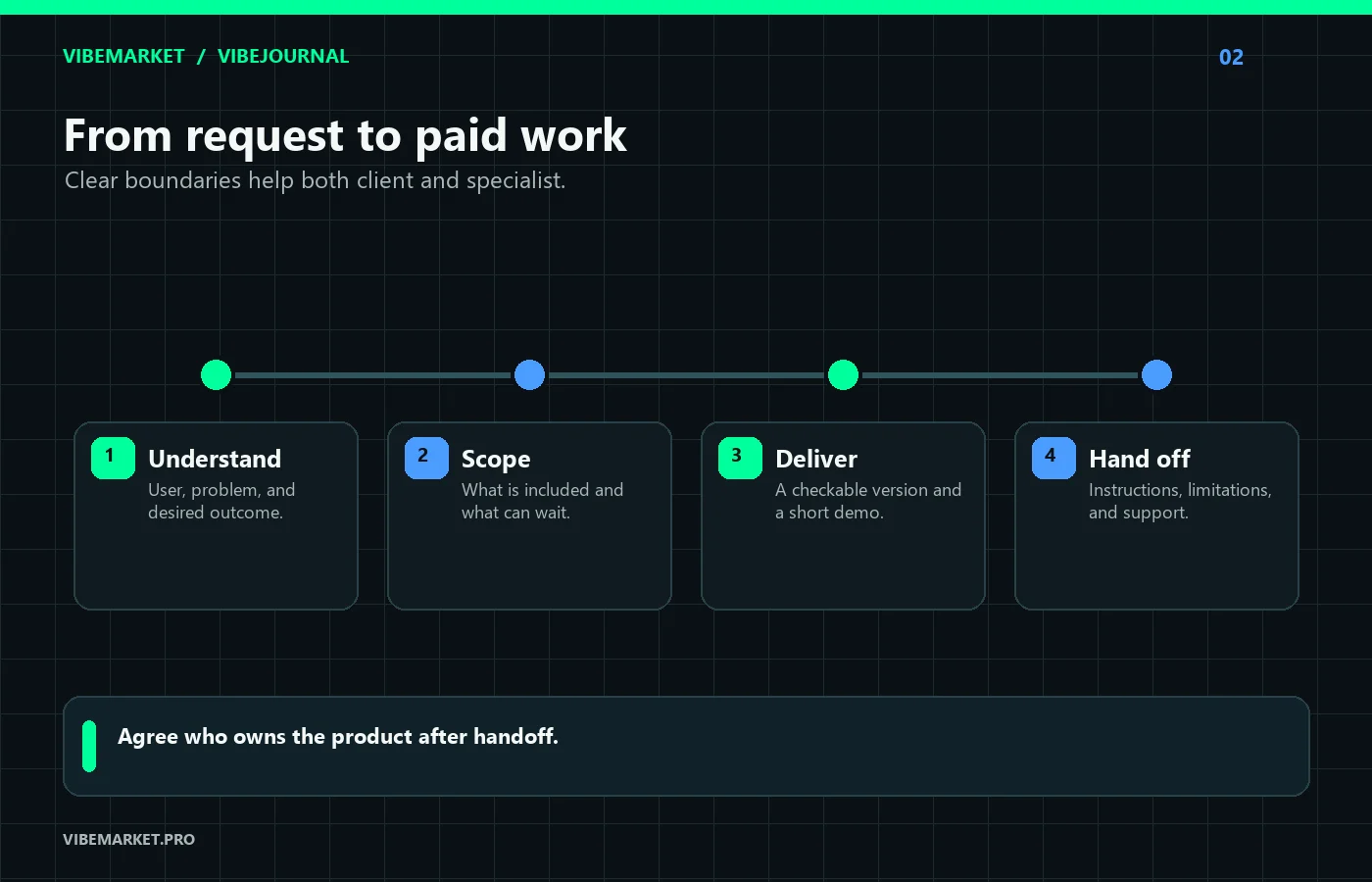
Before estimating, ask the client what happens today and where the trouble starts. Clarify who will use the result, what a successful flow looks like, and which systems are already involved. If the request is a feature list, ask the client to walk through one example from beginning to end. That can reveal whether they need a new feature, a spreadsheet connection, or a clearer process.
Split the work into stages with checkable outcomes. For example, agree on the flow and a sketch, build the working path with test data, check any integration, then prepare the handoff. The client can review an intermediate result and correct the next step while the scope is still manageable.
Agree on who provides access and materials. Do not ask for a personal password in a message; use an appropriate way to grant and revoke access. Confirm whose account will host the service, who owns the domain and data, who pays for third-party services, and who can restore the system after a failure. These details may seem administrative until handoff, when the client and contractor discover they expected the other person to handle them.
Write acceptance checks in plain language. "The form is done" does not say whether requests are saved, the owner receives a notification, or the user sees an error message. Describe a few observable outcomes and agree on who will check them. That gives the task a clear finish. A later request for "one more small thing" can then be scoped and estimated separately.
Estimate scope and risk
Before quoting a price, list the unknowns: access rules, data readiness, the behavior of external services, and support expectations. The more open questions there are, the less reliable a fixed estimate becomes. Sometimes it makes sense to begin with paid discovery or a prototype, then price implementation when the scope is clearer.
For a fixed stage, state what is included and how many correction rounds apply to the agreed checks. New fields, integrations, or rule changes after acceptance may need a separate estimate. For longer work, agree on intermediate reviews and how new requests will be approved. The client knows what they are buying, and the contractor avoids an undefined commitment.
Remember the work around code generation. You still need to understand the client's process, check the flows, handle feedback, prepare a handoff, and sometimes explain how to use the result. If the estimate covers only the first build, any issue after the demo becomes unplanned work.
Be clear about your experience too. If a task involves payments, access control, or sensitive information, state which part needs a specialist. That may affect timing and budget, but it shows the client where your current scope ends.
If you are building your own product
An independent product requires you to test its usefulness and find a way to reach users. Start by describing who has the problem, what they do now, and which change you want to test. Ask potential users about their current process. Interest in an idea is useful, but a concrete account of a recent situation says more about how someone handles the task today.
Then try delivering the service manually or show a prototype without building complex infrastructure. You are checking whether people understand the offer, what questions they ask, and whether they can complete the main flow. If feedback points to confusion, rewrite the explanation or simplify the path before adding features.
Before a working version goes live, decide who handles requests, fixes, backups, and third-party service costs. If it remains an experiment, limit your promises and decide how long you keep data. If clients continue to use it, support becomes part of the product and needs ongoing time.
An independent product leaves the decisions and possible income with you, along with every unresolved task. AI may shorten a particular change; it does not bring users or decide which requests deserve attention. Income depends on finding a recurring need and a way to reach people who have it.
What to show in a portfolio and a brief
Choose one project and describe it plainly: whose problem it addresses, what works, which data you used, what you checked, and which limits remain. Show the user flow, not just the home screen. If the build uses test data, say so beside the demo.
A client brief benefits from a few direct questions:
- How does a user start and finish the task?
- Where is the result stored, and who can see it?
- Which errors or exceptions already occur?
- Which outside systems need to connect?
- Who will review and accept each stage?
- Who pays for, supports, and restores the service?
The answers show whether the task fits your experience and can be estimated without hidden requirements. On VibeMarket, state these limits in your profile or project description. If a developer is needed for a complex area, pass along a specific question and the current state of the project, not a claim that AI has already done most of the work.
Choose a path that fits how you work
Freelancing suits people who are willing to clarify requirements, explain limits, and agree on an outcome. An independent product suits someone who wants to set the direction and is ready to test demand, distribution, and support at the same time. A team role offers product context and review from colleagues, but it requires you to work within shared rules and own your part of a larger process.
Think about which part would be hardest for you: client conversations, a long period without evidence of demand, or an unfamiliar existing project. Then try a small step in that model: discuss a task with a potential client, show a prototype to a user, or make a scoped change in a project and get it reviewed. You will learn whether you enjoy the work without turning the choice into speculation about possible income.
Keep a short note for each project: what you promised, how often the criteria changed, what checks were needed, and what you supported after handoff. A few projects will show which services you can repeat reliably and where you underestimate the effort. Do not promise a deadline or outcome just because a similar task went quickly once.
Before accepting an unfamiliar project, ask what happens if the result fails after handoff and who can restore it. If the answer is unclear, scope a discovery or review step first. A small contract with a clear owner is easier to deliver than a broad promise that quietly includes support, security, and product decisions.
FAQ
Can I make money with vibe coding without programming skills?
You can begin with simple tasks whose results are easy to check. Supporting a real product requires an understanding of data, permissions, errors, and the effects of changes; complex areas should be reviewed or handled by a specialist.
What is easier for a first payment: freelancing or a product?
There is no universal answer. A service can have a defined client and scope; a product requires finding an audience and continuing support. Choose based on how comfortable you are with client conversations, sales, and longer periods of uncertainty.
How should I price work when AI writes some of the code?
Price the task, verification, corrections, handover, and responsibility for the agreed outcome. Using AI may change the workflow, but it does not remove the time needed to understand the problem and check the result.
Can I sell a prototype as a finished app?
Only when its limits are clear and the buyer agrees to them. If the flow has not been checked under real conditions, call it a prototype and describe what is still needed before release.
Should I include ongoing support?
That depends on the product. State whether the engagement ends with a handover or includes updates, bug fixes, and user support, and who pays for infrastructure.
The short version
Vibe coders earn by solving a bounded problem and handing over a clear result, not by generating code. Start with work you can verify and support; expand only when you are ready to own the next level of risk.
Discussion
Comments
No comments yet. Be the first to share your experience.
Sign in to join the discussion →