When Should a Vibe-Coded Prototype Move to Full Engineering?
Six signs that an AI-built prototype should move to full engineering: real data, roles, integrations, rollback, and handover.
ContentsShow sections
Vibe coding is useful while the team is testing an idea. You change a screen, run a workflow, and learn whether anyone wants to use it. The trouble begins when the prototype becomes a working system while the rules around it remain temporary.
The broad question of project fit has a separate guide. This article answers a narrower question: which observable signs mean that an existing prototype should move from rapid experiments to managed engineering?
Why prototype mode ends
Early on, manual steps, a small audience, and simple test data may be fine. The owner can inspect failures each day and explain the next change.
Real users change the cost of a decision. The product now has real records, roles, payments, external services, uptime expectations, and a promise that tomorrow's behaviour will match today's. The code may remain AI-built, but the process cannot remain "try another prompt and see."
Six signs it is time to move
1. A failure affects a real record
If the database contains orders, money, documents, or customer data, changes need a copy, a migration plan, and a rollback check. A project does not stay a prototype just because it has few users.
2. Different roles appear
One screen for the creator and the user quickly becomes a permission model. A manager may change a status, a customer may see only their order, and a supervisor may export a report. Those rules need to be written down and enforced on the server.
3. Integrations become part of the workflow
Email, payments, CRM, inventory, and messaging add retries, timeouts, quotas, and external API changes. If an integration failure can lose a request or create a duplicate, the system needs an owner and a recovery path.
4. Users disagree about the requirements
When one person uses the prototype, ambiguous decisions stay hidden. Once a department joins, "closed request" may mean different things to a manager and a supervisor. The fix is not another screen. It is a shared workflow, vocabulary, and acceptance criteria.
5. The team cannot explain the rollback
If the answer is "we will ask the AI to recreate the previous version," the project has left the safe prototype stage. You need a repository, change history, a data backup, and a tested way to restore the previous release.
6. Support depends on one chat
Launch steps, keys, environments, and design decisions should not exist only in the creator's conversation. Handover becomes part of the product as soon as anyone besides the creator relies on it.
What to keep using AI for
Moving to engineering mode does not mean banning AI. It can still help write tests, find repeated code, explain a module, prepare documentation, analyse logs, and make small isolated changes.
The control point changes. The model proposes a change; a person checks the intent, diff, tests, and data impact. As failure cost rises, the change should become smaller and its reversal more obvious.
A minimum engineering gate
Before the first real launch, document:
- the data model and migration rules;
- roles and allowed actions;
- environment variables and external-account owners;
- tests for the main user workflows;
- a backup and a test restore;
- important events and log locations;
- application and data rollback procedures.
For a web app, OWASP ASVS offers a basis for checking technical security controls, while NIST SSDF gives teams a vocabulary for secure development practices. Use the relevant parts; a small product does not need a ceremonial report that the team will not maintain.
How to decide
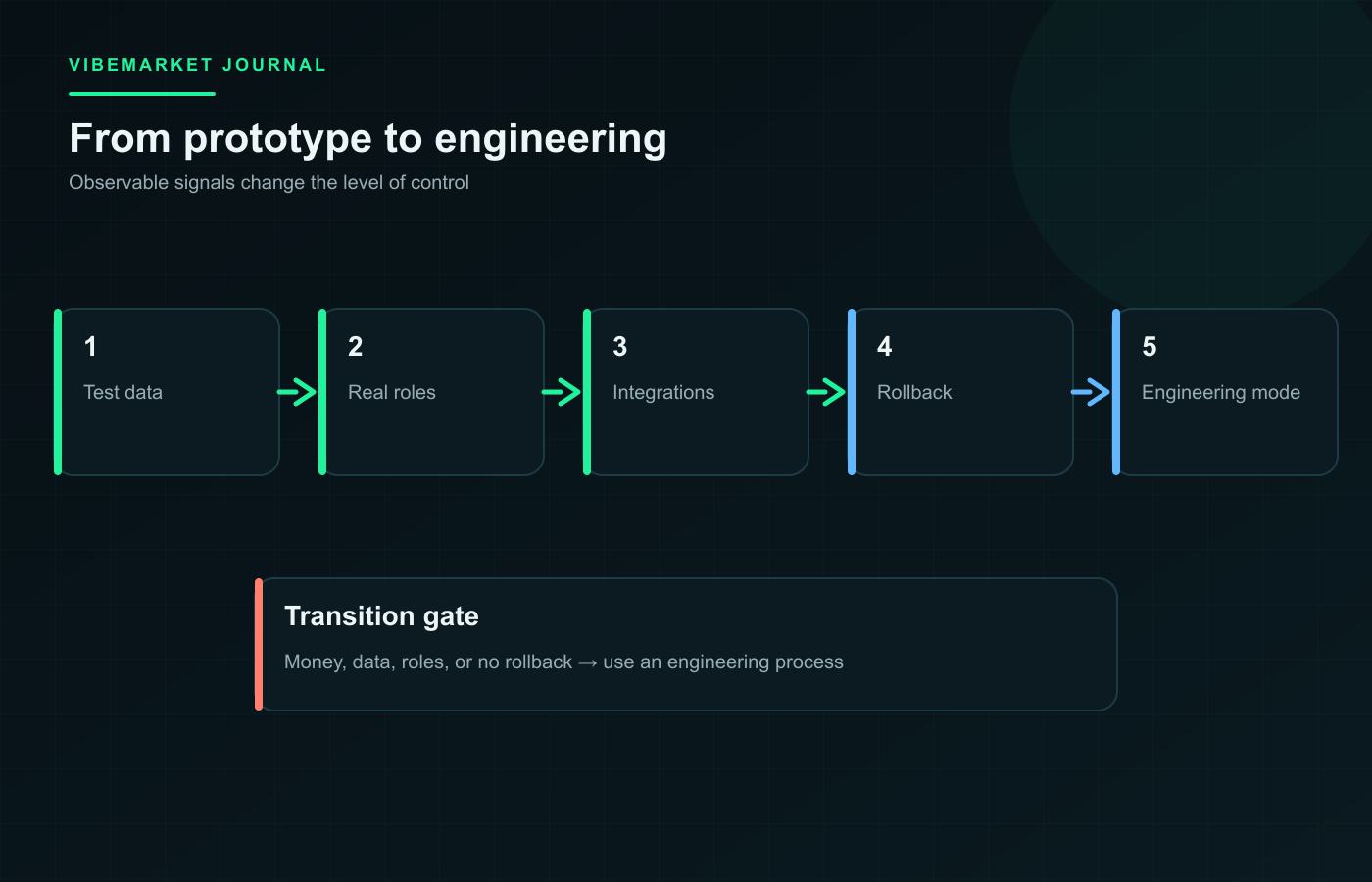
Keep a project in prototype mode when the data is test data, failure is reversible, the audience is small, and one owner can verify the result. Move it to full engineering when it affects money, data access, customer commitments, or a team's daily work.
The key change is responsibility. A VibeMarket request can frame the work as an audit followed by a staged handover: first a risk map and priorities, then fixes with acceptance criteria. That is safer than rewriting an AI-built project blindly because its temporary decisions were not recorded.
Discussion
Comments
No comments yet. Be the first to share your experience.
Sign in to join the discussion →