How Developers Can Find Remote Work in 2026: Jobs, Part-Time Roles, and Freelance Projects
A practical guide to finding remote developer work through stronger positioning, resumes, portfolios, job platforms, applications, interviews, part-time roles, and freelance projects.
In brief
- • Remote developer work includes permanent employment, part-time roles, project contracts, and freelance work.
- • Each format requires a different resume, portfolio, search strategy, and payment arrangement.
- • Clear specialization helps employers and clients understand a developer's relevance more quickly.
- • A portfolio should demonstrate complete working products, personal contribution, and the ability to deliver tasks independently.
- • HeadHunter and Habr Career can be used for remote vacancies, while VibeMarket provides an additional channel for project-based work.
- • A personalized application to a relevant role is stronger than sending the same generic message everywhere.
- • Remote work requires independent communication, regular progress updates, and early reporting of blockers.
- • Project work should define scope, timeline, acceptance, source code handover, and payment before development begins.
- • Developers should use several acquisition channels and review their results every week.
- • A 30-day plan turns irregular applications into a repeatable job-search process.
ContentsShow sections
Remote developer work can refer to very different arrangements.
One developer may be employed by a single company, receive a fixed salary, and work with the same team every day. Another may join a product for several months. A third may complete smaller projects for multiple clients.
All of them work remotely, but they search for opportunities, present their experience, and arrange payment differently.
The search should therefore begin with choosing a format, defining a specialization, and preparing evidence of practical experience rather than sending the same resume everywhere.
Remote work formats for developers
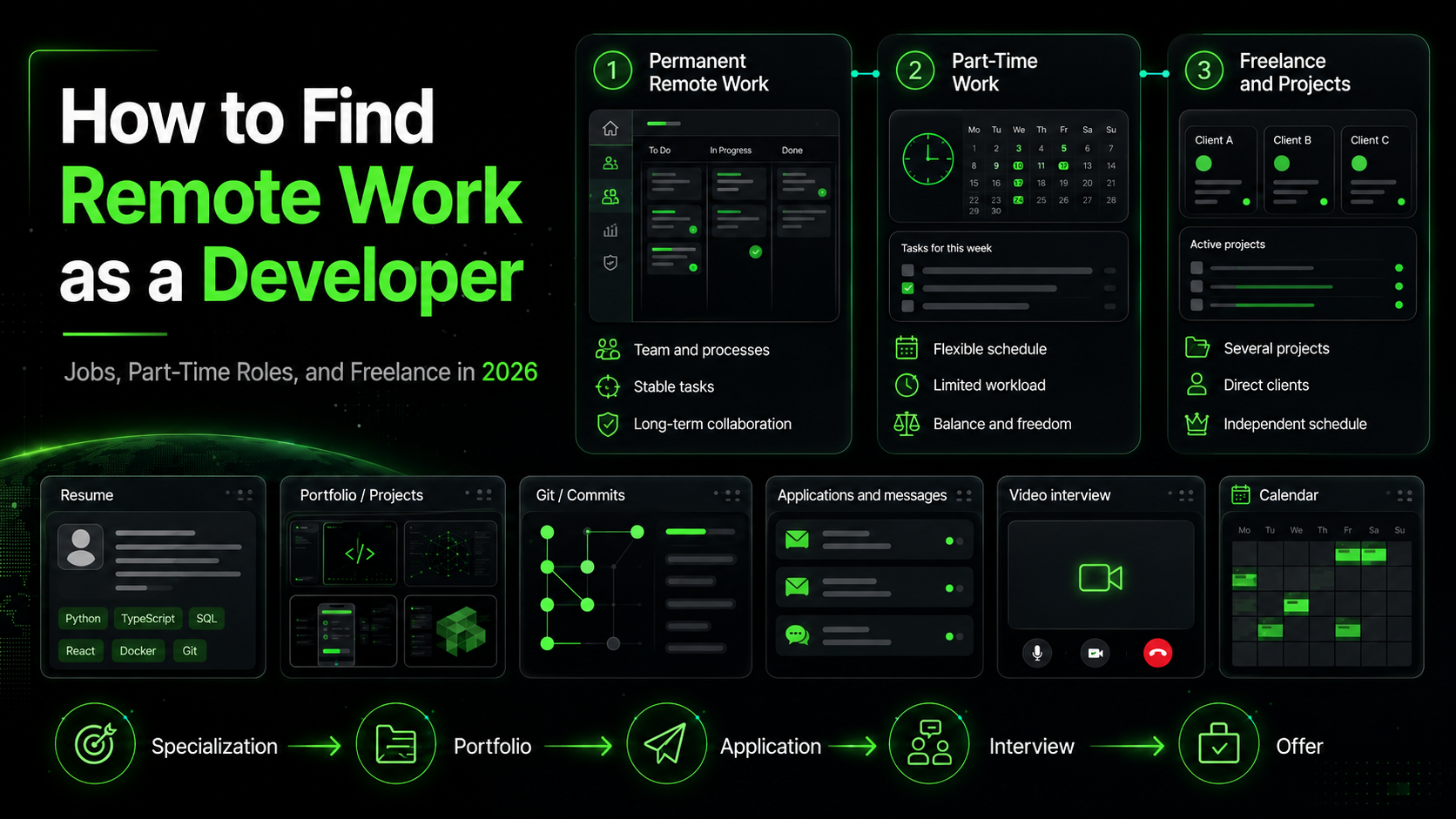
Remote work can be divided into three main formats.
Format | Stability | Freedom | Need to find new work | Responsibility |
|---|---|---|---|---|
Permanent employment | Usually high | Moderate | Low after hiring | Assigned role in a team |
Part-time role or contract | Moderate | Higher | Periodic | Agreed scope |
Freelance work | Variable | High | Continuous | Complete project result |
Permanent remote employment
A permanently employed developer becomes part of one company.
The role normally includes:
a manager;
a team;
a working schedule;
regular salary;
internal processes;
task tracking;
meetings;
code review;
corporate infrastructure.
This format suits developers who value predictable income, one product, and long-term teamwork.
Remote does not always mean working from any country or at any time.
A role may require:
residence in a particular country;
eligibility for local employment;
a defined time zone;
availability during team hours;
occasional office visits;
company-issued equipment;
restrictions on working from certain regions.
Read the complete conditions rather than only the word “remote” in the title.
Part-time roles and project contracts
A part-time developer works a limited number of hours or takes responsibility for a specific product area.
Examples include:
supporting a mobile application for 20 hours per week;
joining a team for three months;
developing one module;
resolving accumulated defects;
helping release an MVP;
conducting a technical audit;
maintaining backend infrastructure.
Before work begins, both parties should agree on:
available hours;
communication schedule;
expected result;
task assignment;
hourly rate or fixed price;
reporting;
payment schedule;
source code rights;
contract termination.
Freelance work
A freelancer manages the entire client relationship independently.
In addition to writing code, they need to:
study the request;
estimate scope;
prepare a proposal;
negotiate;
record requirements;
control the timeline;
manage feedback;
issue invoices or receipts;
transfer source code;
support the result after release.
Freelancing provides freedom but also requires continuous client acquisition and financial discipline.
Developers who only want prepared tasks and a stable team may prefer employment or a contract role.
Step 1. Choose the format you need
Weak goal:
I want a remote programming job.
More useful goals:
I am looking for a full-time remote frontend developer role.
I am looking for a backend contract for up to 20 hours per week.
I build Telegram bots and business automation as a freelancer.
A clear target makes it easier to select platforms, prepare a profile, and evaluate opportunities.
Ask yourself:
Do I need a fixed salary?
Am I ready to find clients independently?
Do I want one product or several projects?
How many hours can I work?
Do I need a flexible schedule?
Am I ready to own the complete project result?
Which time zones can I support?
Which income level provides stability?
Step 2. Define your specialization
An employer may struggle to evaluate a candidate who simultaneously presents themselves as a frontend developer, designer, mobile developer, DevOps engineer, and marketer.
Broad experience is useful, but the primary positioning should remain clear.
Examples:
React and Next.js frontend developer;
Node.js and PostgreSQL backend developer;
Python developer for Telegram bots and automation;
React Native mobile developer;
fullstack SaaS and MVP developer;
business automation developer;
Telegram Mini App developer;
integrations and internal tools specialist.
A useful specialization answers three questions:
What do you build?
Who is it for?
Which main technologies do you use?
For example:
I build Telegram bots and Mini Apps for booking, catalogues, payments, and internal business workflows.
This is clearer than:
General programmer working with every technology.
Step 3. Evaluate your actual level
A level should reflect the tasks a developer can complete independently.
Junior
A junior developer usually:
understands language and framework fundamentals;
uses Git;
runs a project locally;
fixes smaller defects;
completes limited tasks;
asks questions;
works with review from a more experienced developer.
Middle
A middle developer:
implements features independently;
understands project structure;
estimates tasks;
writes and reviews tests;
investigates defects;
participates in code review;
understands the effect of changes on the system.
Senior
A senior developer:
designs solutions;
evaluates risks;
makes technical decisions;
works with performance and security;
supports other developers;
owns large parts of a product;
explains technical constraints to the business.
A title is less important than a clear description of tasks and responsibility.
Step 4. Prepare a resume for the selected format
A resume for employment and a freelance profile solve different problems.
Employment resume
An employer wants to understand:
where and how long you worked;
which role you performed;
which products you worked on;
which systems you owned;
what results you achieved;
how you worked with a team;
which technologies you use;
which employment format you need.
Do not list duties only.
Weak description:
Website development, bug fixing, API work.
Stronger description:
Built a Next.js user dashboard, implemented authentication and REST API integration, added error handling and responsive layouts, and participated in task decomposition and pull request review.
Project-work profile
A client needs to understand:
which problems you solve;
which products you build;
what is included;
which examples are available;
how collaboration works;
how pricing is calculated;
what is delivered at the end.
Example:
I build Telegram Mini Apps and bots for booking, catalogues, customer dashboards, and request automation. Clients receive the repository, deployment instructions, and infrastructure access.
Step 5. Remove irrelevant skills
Do not list every library you have ever opened.
Keep skills that:
match the selected role;
are supported by projects;
are used in practice;
appear in relevant vacancies;
help solve real tasks.
If you are applying as a React developer, a long list containing PHP, Unity, Blender, Figma, 1C, and advertising tools may weaken the positioning.
Additional experience can remain in the profile, but the primary skills should support the target role.
Step 6. Build a portfolio
A developer portfolio should demonstrate the ability to deliver working products.
For every project, include:
name;
problem;
target audience;
personal role;
implemented features;
technology stack;
difficult decisions;
working link;
video or screenshots;
current status;
result.
What matters for remote work
The employer or client should see that you can independently:
understand requirements;
divide work into stages;
report progress;
communicate blockers;
complete a task;
deploy or hand over the result.
When there is no commercial experience
Use personal projects, but turn them into complete products.
Instead of another basic task list, build:
a booking service;
a Telegram Mini App;
a request dashboard;
an application with authentication;
a catalogue with administration tools;
a small SaaS;
a mobile application;
an automation tool.
Add:
a working link;
a database;
error handling;
responsive design;
documentation;
tests;
development history.
A small completed product is stronger than a large project that cannot be launched.
Step 7. Prepare GitHub
GitHub does not replace a portfolio, but it can demonstrate work quality.
Check:
repository names;
README files;
clear project purpose;
setup instructions;
removal of secrets;
clean file structure;
understandable architecture;
meaningful commit history;
working links.
Commercial source code does not need to be public. You can provide open demonstration repositories and describe closed products in the portfolio.
Where to find remote developer work
HeadHunter
HeadHunter can be used for:
permanent employment;
formal contracts;
internships;
junior, middle, and senior roles;
full-time and part-time positions.
Use filters for:
remote work;
specialization;
experience;
employment type;
schedule;
salary;
publication date.
Search by specific roles rather than only “programmer”:
frontend developer;
backend developer;
React developer;
Python developer;
mobile developer;
fullstack developer;
software engineer.
Habr Career
Habr Career focuses on technology roles.
Search by:
specialization;
technology;
qualification;
remote format;
full-time or part-time work;
seniority.
Complete the profile carefully and include real skills, experience, projects, and preferred work format.
Company career pages
Some roles are published on company websites before appearing on aggregators.
Create a list of employers that interest you:
product companies;
development studios;
startups;
banks;
marketplaces;
companies related to your technology.
Check their career sections and subscribe to updates where possible.
Professional communities
Useful channels may include:
Telegram job channels;
technology chats;
conferences;
meetups;
open source projects;
alumni communities;
personal recommendations;
technical publications.
Avoid posting:
I need any job. Please hire me.
Instead, state:
specialization;
level;
preferred format;
technology stack;
project link;
target task type.
VibeMarket
VibeMarket can be used as an additional channel for project-based work.
Developers can:
create a profile;
define a specialization;
add working products;
provide videos and screenshots;
respond to project requests;
arrange project collaboration.
It complements rather than replaces employment platforms.
Step 8. Create a search system
Avoid opening dozens of random pages every day.
Choose:
two primary vacancy platforms;
one project-work platform;
a list of target companies;
one or two professional communities;
a simple application tracker.
Track:
Field | Information |
|---|---|
Company or client | Name |
Role or task | Opportunity |
Date | Application date |
Source | Where it was found |
Status | No response, interview, rejection, offer |
Next action | Follow up, test task, call |
Notes | Conditions or feedback |
After several weeks, you will see which channels and messages produce responses.
How to write a cover message
The message should be short and related to the specific role.
Weak version:
Hello. I am interested in the position and can complete a test task.
Stronger version:
Hello. I am a frontend developer working with React, Next.js, and TypeScript. In my latest project, I built a user dashboard, authentication, and REST API integration. Your product interface and component-system tasks are especially relevant to my experience. I have attached a related project and a short explanation of my contribution.
A project proposal should focus on the client's task:
I reviewed the request. You need a Telegram Mini App with a catalogue, cart, and administration panel. I suggest defining the roles, payment model, and first-release scope before estimating. I have launched a similar product with Telegram authentication. To prepare an accurate estimate, I need to know the number of products and CRM requirements.
How to personalize an application
Before sending, check:
Does your specialization match the opportunity?
Do you have a relevant example?
Did you mention specific requirements?
Is your contribution clear?
Is there a working project link?
Does the message sound generic?
Is the next step clear?
Personalization does not require a long letter. It only needs to show why your experience matches the role.
Why mass applications often fail
Sending the same message everywhere creates activity but does not improve positioning.
When responses are rare, the problem may be:
overly broad specialization;
incorrect role level;
weak resume;
no working projects;
generic messages;
unrealistic expectations;
outdated skills;
unclear contribution.
Track conversion:
applications sent;
resume views;
responses;
interviews;
test tasks;
offers.
Interview preparation
Before an interview, review:
the company product;
the role description;
technology stack;
expected tasks;
experience requirements;
team format;
remote-work conditions.
Prepare examples involving:
a difficult bug;
a completed feature;
changing requirements;
team collaboration;
an inaccurate estimate;
a solution that required redesign;
a project you are proud of.
The goal is not to memorize perfect answers. It is to explain actions and decisions clearly.
Technical interviews
During a task:
clarify requirements;
explain your reasoning;
state assumptions;
test edge cases;
admit when you do not know something;
suggest how to find an answer;
explain trade-offs.
Employers evaluate the process as well as the final code.
Evaluating a test task
A reasonable task:
matches the role;
has limited scope;
provides clear criteria;
does not require a complete commercial module;
has a stated review period.
Warning signs include requests to:
build a large part of a real product;
complete several days of unpaid work;
connect directly to a production system;
transfer all rights without discussion;
pass several large unpaid stages;
work without criteria or feedback.
Clarify:
expected scope;
suggested time limit;
review deadline;
delivery format;
permitted libraries and AI tools;
whether feedback is provided.
Skills required for remote work
Remote development requires more than technical expertise.
Written communication
A developer should clearly describe:
progress;
problems;
questions;
risks;
results;
next steps.
Self-organization
Developers need to:
plan the day;
prioritize;
meet deadlines;
track tasks;
record decisions;
report delays early.
Blocker management
Weak behavior:
The developer remains silent for three days because API access is missing.
Strong behavior:
I need an API key to continue. While waiting, I completed the interface and added test data. If access is not available by Wednesday, the integration deadline will move by one day.
Transparency
A remote team cannot observe work directly.
Useful signals include:
status updates;
task records;
commits;
pull requests;
short reports;
clear estimates;
documented decisions.
Finding part-time work
Part-time work can provide additional income and experience, but it should not conflict with a primary employer.
Review:
the employment agreement;
outside-work rules;
confidentiality terms;
competitor restrictions;
source code ownership;
working-hour overlap;
employer equipment policies.
Do not use:
company devices without permission;
private company code;
corporate accounts;
customer data;
internal libraries;
secret keys;
paid employer time.
Limited tasks are often safer for part-time work:
audits;
consultations;
bug fixes;
small bots;
integrations;
landing pages;
a few hours of weekly maintenance.
Working with project clients
Before development, agree on:
result;
scope;
timeline;
price;
stages;
payment process;
acceptance criteria;
included corrections;
source code handover;
post-release support.
“Build a website” is not enough.
Define pages, features, integrations, and source materials.
Larger projects can be divided into:
Discovery.
Prototype.
Main development.
Testing.
Launch.
Support.
Handling project income
The appropriate legal and tax structure depends on the country, contractor status, client, and work arrangement.
Before beginning, determine:
who the client is;
how the agreement is recorded;
which document confirms payment;
who owns the code;
how delivery is accepted;
whether a receipt or invoice is required;
which taxes apply.
This section is general information rather than individual legal or accounting advice.
Recognizing fraudulent offers
Stop communication when a supposed employer or client:
asks you to pay for vacancy access;
requires purchasing training;
offers to receive and transfer other people's money;
asks you to install unknown software;
requests banking information before verification;
hides the company identity;
promises high income without selection;
sends suspicious files;
wants to use your account for transactions;
requests large unpaid work;
pressures you to share documents or verification codes.
Verify:
the company website;
legal information;
corporate email;
the representative's profile;
previous vacancies;
contract conditions;
reviews from several sources.
Never share SMS codes, banking access, seed phrases, passwords, or two-factor authentication keys.
How to present AI-tool experience
Experience with Cursor, Claude Code, Codex, and other agents can be valuable when the developer controls the result.
Employers and clients want to know:
how you review diffs;
whether you run tests;
whether you can explain changes;
whether you can fix errors without blindly copying;
whether you check security;
whether you take responsibility for the final code.
Weak description:
I build projects with AI.
Stronger description:
I use AI agents for repository analysis, refactoring, and test preparation. I review every change through diffs, builds, and critical user flows.
A 30-day remote job-search plan
Week 1. Positioning
choose a work format;
define the main specialization;
review relevant vacancies;
identify repeated requirements;
update the resume title;
remove irrelevant skills;
prepare a concise experience summary.
Result: a clear explanation of which work you need and why you are suitable.
Week 2. Evidence
select two or three strong projects;
verify working links;
describe personal contribution;
prepare screenshots;
record short demonstrations;
update GitHub;
complete profiles on selected platforms.
Result: employers and clients can see finished products rather than only a technology list.
Week 3. Systematic applications
choose relevant roles;
send personalized messages;
record applications;
respond to project opportunities;
participate in professional communities;
contact target companies;
analyze rejection reasons.
Result: you begin collecting data about effective channels and messages.
Week 4. Improvement
complete a practice interview;
review weak technical topics;
improve the resume;
strengthen project descriptions;
update the application message;
remove ineffective channels;
increase activity where responses appear.
Result: searching becomes a repeatable process rather than a set of random applications.
Measuring results
Record weekly:
relevant vacancies found;
applications sent;
resume views;
responses;
interviews;
test tasks;
offers;
common rejection reasons.
Many applications with few views may indicate a weak title or resume.
Views without responses may indicate insufficient relevant experience or an unclear portfolio.
Interviews without offers may require improvements in technical preparation, communication, or condition expectations.
Using VibeMarket
Developers can use VibeMarket to create a profile, add working products, and respond to project requests.
The profile should state:
specialization;
technology stack;
product types;
real projects;
personal role;
work format;
availability;
testing and handover approach.
Use VibeMarket as one part of the search system.
For example:
HeadHunter for permanent employment;
Habr Career for technology roles;
VibeMarket for project requests;
professional communities for referrals.
Create a developer profile on VibeMarket
Final thoughts
Finding remote developer work requires more than publishing one resume and waiting.
A developer should:
choose a work format;
define a specialization;
evaluate their level honestly;
prepare a relevant resume;
demonstrate working products;
use several channels;
write personalized applications;
improve remote communication;
agree on conditions before work begins;
review search results regularly.
Remote opportunities usually go not to the person who lists the most technologies, but to the developer who explains their value clearly, proves it through completed products, and can deliver work independently.