Is Vibe Coding Good for Internal Business Tools?
Find out which internal business tools fit vibe coding, what limits still matter, and the five questions to answer before a pilot.
ContentsShow sections
An internal tool rarely has to please the entire internet. One team uses it, the workflow is usually known, and feedback comes from people who face the problem every day. That makes internal business tools strong candidates for AI-assisted development, often more suitable than a public product.
Why an internal tool is easier than a public product
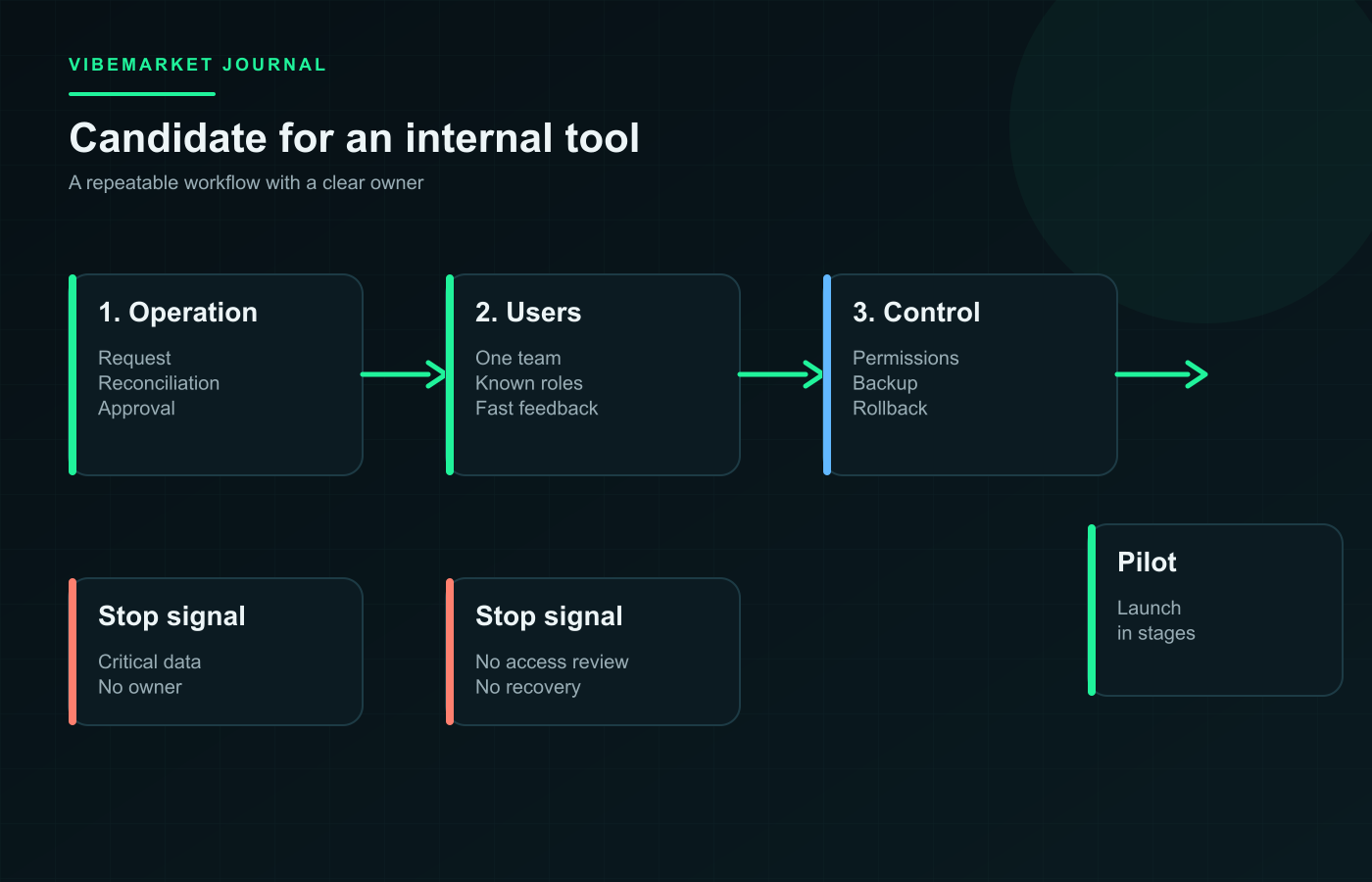
A public service must explain itself to strangers, handle many devices, and survive uses the team did not predict. An internal tool often starts with a narrower job: review a request, approve an expense, find an order, reconcile two lists, or produce a report.
That does not make it safe by default. It does reduce the area you need to understand and test. The process has an owner, users are available for feedback, and an unclear rule can be settled before it becomes a permanent part of the code.
Good candidates
Common candidates include:
- an order dashboard with filters and statuses;
- a support or operations queue;
- an approval form for expenses, leave, or content;
- a calculator with a clear formula and an export;
- an internal document catalogue with search and roles;
- a partner portal with a few repeated actions;
- a reconciliation tool that flags differences between lists.
The shared trait is a repetitive manual operation. The first release does not need to become a company-wide platform. It needs to remove one source of lost time and leave a trace: who entered the data, who changed it, and what happened next.
Where vibe coding helps
AI can speed up repeated pieces: lists, filters, forms, role-aware screens, and notifications. It also helps when the team refines an interface against real examples. A user may say, "I cannot see why this request was returned," which becomes a concrete requirement for a status and a change history.
The work still needs to be sliced. Describe the workflow on one page, then build one user path. Do not start with "build a company portal." A portal has too many owners, exceptions, and promises about the future.
What limits still matter
An internal tool may contain personal data, salaries, commercial terms, or client documents. A permission bug can expose information even when no public audience is involved.
Before a pilot, cover at least:
- separate roles and server-side permission checks;
- a backup and a tested recovery path;
- an inventory of integrations and key owners;
- a history of important actions;
- a way to disable or roll back a bad change.
If the tool depends on email, messaging, accounting software, or file storage, test more than the happy path. What does an operator see during a timeout? Does a retry create a duplicate notification? Who learns that a sync has stopped?
A five-question test
An internal tool is a good vibe-coding candidate when you can answer these questions precisely:
- who uses it and how many roles are needed;
- which one action should become faster or more reliable;
- which data each role must not see;
- how you will test the result with a test record;
- what happens when the database or an integration is unavailable.
An unclear answer does not mean "AI is forbidden." It means the process and ownership need work first. For sensitive workflows, AI can remain inside a controlled engineering process for tests, documentation, isolated screens, and diagnosis.
How to start without a big platform
Choose one department and one data set. Before the pilot, name the person who approves changes, owns access, and decides what success means. Run the workflow in a test environment, collect failures from real users, and add roles only after the first path is stable.
A good internal tool can grow because its data model and permissions are explicit. A weak pilot is not fixed by adding more screens. A VibeMarket brief is stronger when it describes the manual operation, a sample input, and the desired result. That gives a developer enough context to propose a small tool instead of an oversized system.
Discussion
Comments
No comments yet. Be the first to share your experience.
Sign in to join the discussion →