Can You Build an Online Store With Vibe Coding?
Learn which online stores fit vibe coding, when an AI-built ecommerce MVP is enough, and when payments, inventory, and roles need engineering review.
ContentsShow sections
If a shop needs to test demand for a small product line, it does not have to start with a large ecommerce platform. A catalogue, product pages, a cart, and an order flow can be a sensible first project for AI-assisted development. "Build a storefront" and "run complex commerce reliably" are different jobs.
What you can realistically build
A first version can include:
- a catalogue with categories, search, or filters;
- product pages with images, variants, and simple stock rules;
- a cart and checkout flow;
- a customer account with order history;
- a small admin panel for products, statuses, or requests;
- a fixed discount or simple promo code.
AI is useful for repetitive pieces: forms, tables, CRUD screens, responsive layout, validation, and test data. The product owner still has to define the rules. What is the price? When is an order accepted? What does the customer see after a payment timeout?
When it is enough for an MVP
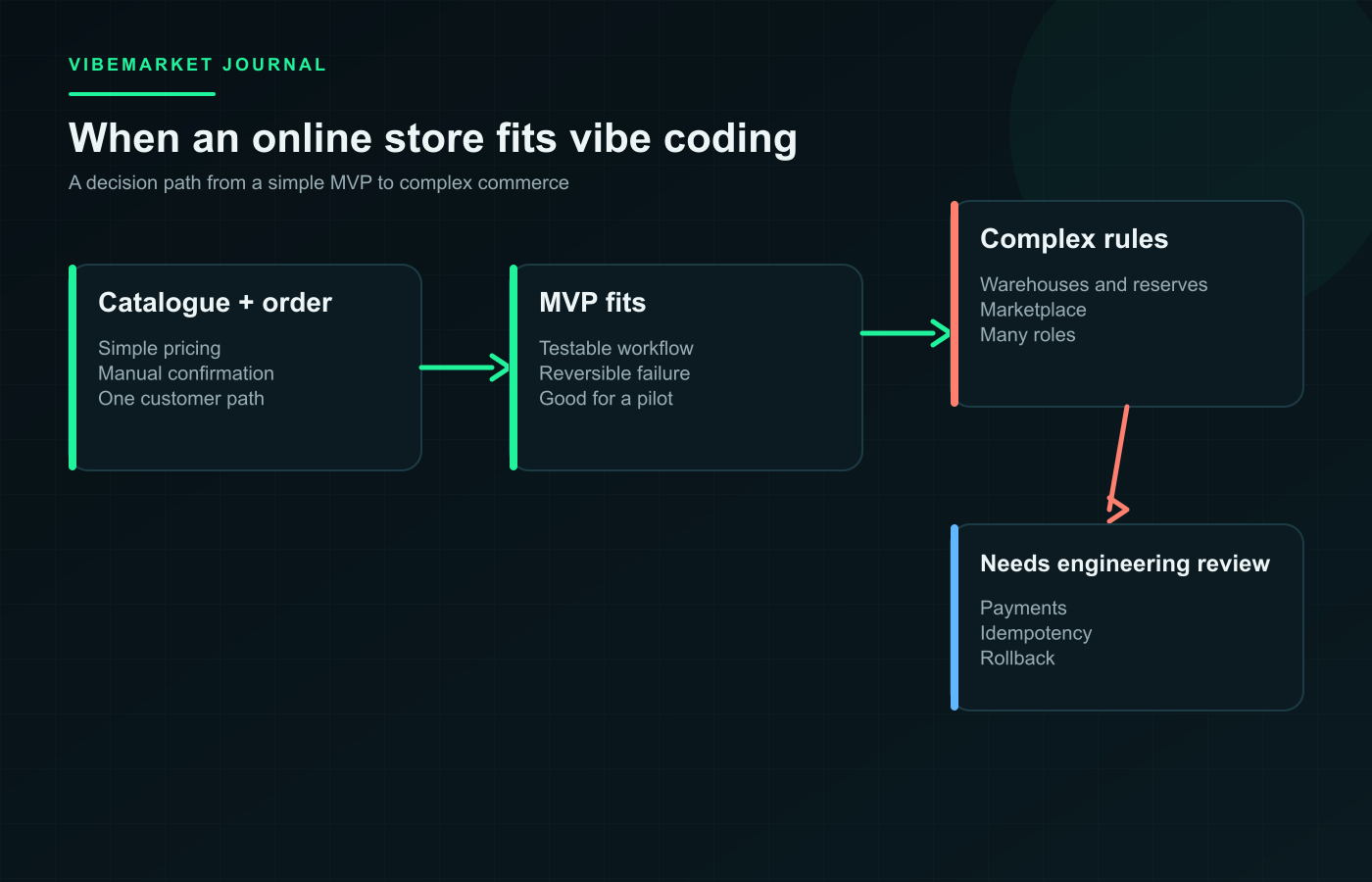
Vibe coding is a good fit when the first version tests one clear hypothesis. A manufacturer may want to learn whether customers will order a short product line directly. A local brand may test pre-orders. A workshop may collect requests for products with a few configurable options.
The MVP is easier to control when it has:
- one main customer type and one clear path from product page to order;
- a small set of pricing and delivery rules;
- a limited admin permission model;
- a way to review an order manually before fulfilment.
For an early test, the site may not need to collect card details itself. It can create an order request and send the customer to a hosted payment page. Stripe, for example, documents hosted Checkout, embedded forms, and more custom components. That does not remove the need to verify payment status, refunds, and webhooks, but it can keep the first build focused. The right option depends on the country, provider, and business requirements.
When traditional engineering becomes necessary
Commerce gets harder when one order triggers many dependent rules. Stock may need to be reserved during payment, several warehouses may compete for the same item, delivery may depend on region, and a promotion may combine customer segment, coupon, and order history. A polished screen cannot prove that this state machine is correct.
A marketplace is another boundary. Multiple sellers introduce commissions, split payouts, disputes, refunds, seller and buyer roles, and sometimes additional documentation. Vibe coding can speed up screens and tests, but payment logic, idempotency, and the ledger of money movements need review by an engineer who owns the architecture.
You also need a more formal process when the store must run continuously, stores sensitive data, connects to inventory software, or has no human watching it overnight. Backups, monitoring, access control, rollback, and dependency review matter here. NIST SSDF and OWASP ASVS are useful reference points for secure development and web-application verification; neither is an automatic compliance certificate.
Payments and customer data
The main ecommerce risk is not the look of the cart. It is a wrong amount, a duplicate order, or a refund applied to the wrong transaction. Before launch, test:
- whether a repeated webhook creates a second order or refund;
- whether the server confirms payment instead of trusting a browser parameter;
- whether staff can see the order-status history;
- whether secret keys stay out of client-side code and the repository;
- whether a timeout or cancellation produces a clear customer message.
PCI DSS is a separate responsibility shared by the business and its payment providers. A hosted checkout can reduce the amount of payment UI you operate, but it does not make the whole store automatically compliant.
Who benefits most from this approach
Vibe coding makes sense for a small brand, a focused manufacturer, a service business selling a defined package, a local shop with manual confirmation, or a team testing a new sales channel. It is a weak fit for a business with several warehouses, complex pricing, a high cost of an incorrect order, and no owner for operations.
A short decision checklist
Ask five questions before starting:
- Which single workflow must the MVP prove?
- Can the pricing and delivery rules fit on one page?
- Who will test payments, refunds, and repeated notifications?
- How will orders be restored after a database or integration failure?
- Which steps can be manual, and which must work without a person?
If the answers are simple and testable, an AI-built store can be a reasonable first step. If every answer turns into a separate operating policy, plan for engineering support and staged delivery from the start. A VibeMarket request is easier to estimate when it includes the order workflow and acceptance criteria, not just "build an online store."
Discussion
Comments
No comments yet. Be the first to share your experience.
Sign in to join the discussion →