Vibe Coding for Small Business: What Can You Actually Build?
Landing pages, portals, catalogues, Mini Apps, and order tools for small business: choose a first task without trying to automate everything.

ContentsShow sections
Small businesses rarely need their own version of a large platform. The pain is usually narrower: leads disappear in chat, customers cannot see an order status, a catalogue is updated by hand, or a manager reconciles spreadsheets every evening. Vibe coding is useful when it removes one such operation and leaves a result the team can verify.
Good first candidates
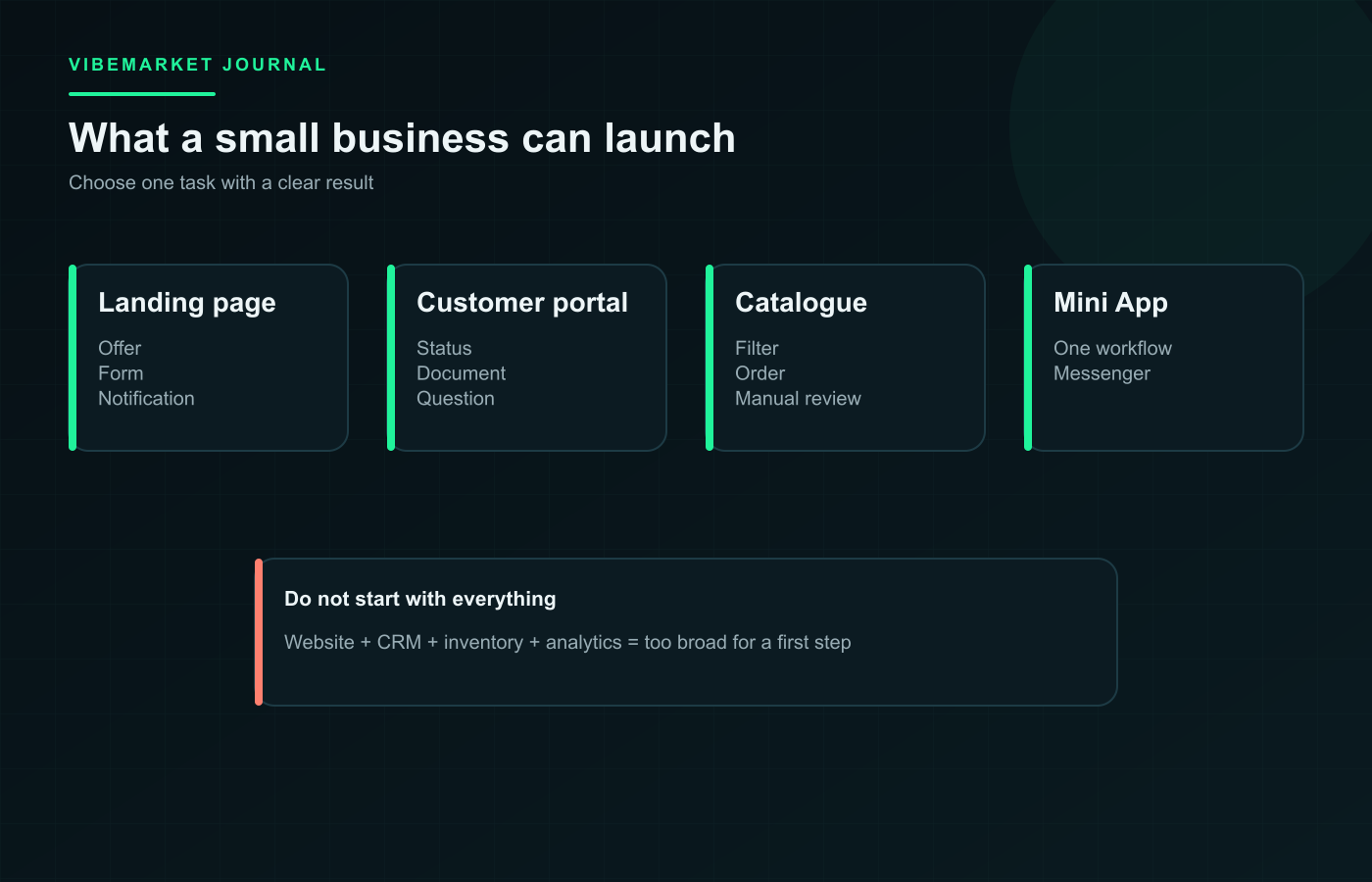
A first AI-built release usually works best with a small permission model and a clear finish line:
- a landing page with a lead form and staff notification;
- a customer portal for orders or documents;
- a service or product catalogue with filters;
- an appointment, booking, or pricing form;
- a small order service with manual confirmation;
- a Telegram Mini App for one repeated action;
- an internal tracker with roles, statuses, or search;
- a calculator that explains its result and saves a request.
These projects can be checked against a few real scenarios. If a user clicks a button and the business does not know what happens next, the app has added a screen, not solved the workflow.
Landing pages, portals, and forms
A landing page is a sensible entry point when the goal is to test an offer and collect contacts. Do not stop at the layout. The form must deliver the request, show a useful error when delivery fails, and avoid creating five copies after a repeated click.
A customer portal helps when people return for a status, document, or repeat order. The first version may need only one or two actions: view a request, download a file, or ask a question. Complexity arrives when one person can act for several companies or see records belonging to other employees.
Booking and pricing forms work when the rules fit on a page without a long list of exceptions. If the final amount needs a human review, label the result as an estimate and pass the request to staff. A precise number that the team cannot defend is worse than a clear preliminary quote.
Catalogues, orders, and Mini Apps
A catalogue for a local brand, studio, or service business does not require a complex commerce platform if stock and delivery are handled manually. An order tool still needs to save the input, status, customer contact, and change history. That is a small operations system, not "just a form."
A Mini App can make sense when the audience already uses a messenger and the action is repeated: choose a service, book a slot, check an order, or submit a reading. Do not move the whole website into a new format because it is fashionable. Test one short workflow first.
Where expectations are too high
Vibe coding does not remove the cost of complicated rules. Expectations usually run ahead of reality in three places:
- the brief asks for a website, CRM, inventory, and analytics at once;
- an integration is treated as "done" because the vendor has an API;
- a demonstration of one happy path is accepted as a working process.
External services have limits, failures, permissions, and changing responses. Databases need migrations and backups. Employees use systems differently from the person who wrote the brief. Those conditions belong in the task before the first screen is built.
How to choose the first project
Rate each idea against five questions:
- how many manual steps does it remove;
- how many roles and exceptions must it support;
- what does a failure cost;
- can the result be tested with sample data;
- who owns it after launch.
Start with a task where the value is visible and a mistake can be reversed. Do not start with payments, medical data, complex accounting, or irreversible operations without an experienced engineer and a named process owner.
A practical start
Describe the current operation, attach a sample request or spreadsheet, name one result, and define how it will be accepted. Then ask a developer for a narrow pilot and a list of what is intentionally out of scope.
That is more useful for a small business than a promise to "build an app with AI quickly." A good first project does one job clearly, keeps the data under control, and shows whether expansion is justified. A VibeMarket brief can help compare developers by the result they propose, not by the number of features they mention.
Discussion
Comments
No comments yet. Be the first to share your experience.
Sign in to join the discussion →