Can You Launch a Paid Product Built With AI?
Can you sell an AI-built product? Check value, payments, access delivery, support, refunds, and readiness for a limited launch.
ContentsShow sections
Most customers do not care whether the code was written by hand, with AI assistance, or with a visual generator. They pay for an outcome: complete a job, receive the promised service, keep their data, and get help when something breaks. A paid AI-built product is therefore a responsibility question, not an authorship question.
What the customer is paying for
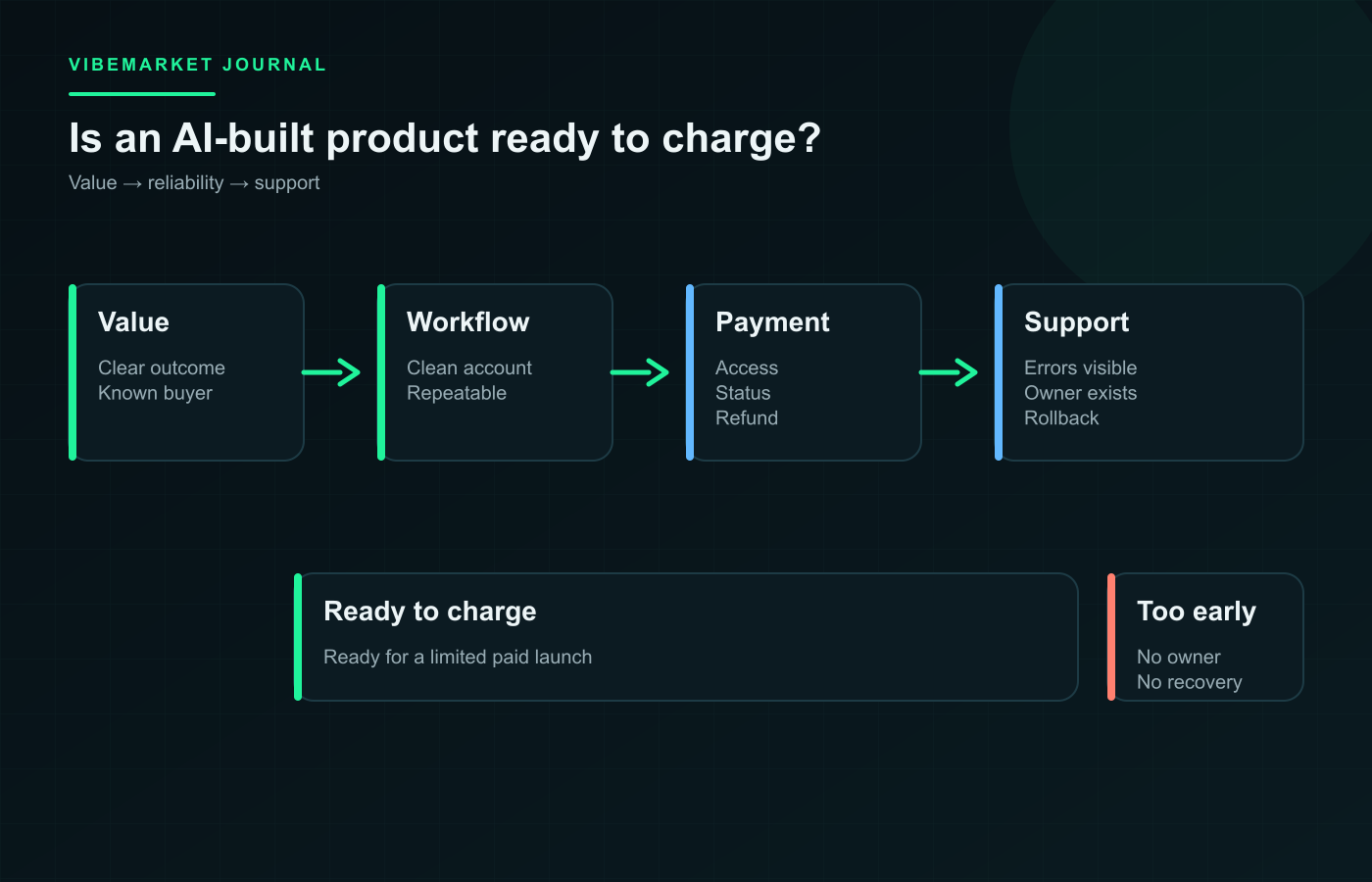
A paid product should deliver a clear value in a repeatable workflow. That may be a report, a dashboard, an automation, access to a feature, or a handled request. Before launch, define:
- who pays and what job they are trying to complete;
- what the paid result includes;
- which limitations are visible before payment;
- what happens after an error or cancellation;
- who provides support and what response to expect.
If the value proposition is only "this was built with AI," there is nothing to sell yet. AI is a production method, not evidence that the product is useful.
What must be ready before the first payment
Minimum commercial readiness includes more than a payment page:
- the main workflow reaches its result on a clean account;
- payment creates a clear state and a repeated callback does not duplicate access;
- user data and permissions are separated;
- someone owns the repository, domain, database, and external accounts;
- errors are logged, backups exist, and rollback is possible;
- support, refunds, and integration failures have an owner and a procedure.
Subscriptions add cancellation, failed renewal, plan changes, and the state after a paid period ends. Digital goods need access delivery, re-download, and revocation. A service with human work needs a queue, a response expectation, and a way to correct a wrong result.
Where caution is justified
Be more careful with payments, personal or medical data, important documents, automated decisions, or data whose loss would stop the business. A demo and a few successful purchases are not enough for those systems.
Review permissions, secrets, error handling, and recovery. OWASP ASVS can provide a technical checklist for a web application. NIST SSDF offers a vocabulary for secure development practices. Neither source turns an AI-built product into an automatic compliance result; the obligations depend on the product and market.
How to launch commercially
Start with an offer the team can support, including manual work where the customer understands the terms. Run several complete sales cycles and test failure handling inside them. That is more useful than creating ten pricing tiers before the first workflow is stable.
Write down blockers before launch and keep them separate from cosmetic improvements. "No database recovery path" and "the animation is not perfect" can sit in one tracker, but they are not the same risk.
After the first paid users, track more than payment count. Look for access-delivery failures, refunds, manual corrections, repeated support questions, and cases where the team cannot explain an order state. Those signals tell you what to strengthen before expanding the offer.
When it is too early
It is too early to sell when the product works only on the creator's account, needs hidden manual intervention, loses data on a retry, cannot revoke access, or has no support owner. It is also too early when the price promises an outcome the team has not reproduced on test workflows.
A closed pilot can be reasonable if its status and limits are clear. "Beta" should not hide a critical defect. Customers need honest terms and a way to report a problem.
A pre-price check
Ask an independent person to act as a customer: sign up, pay, receive the result, trigger an error, cancel, and ask for help. Then act as the owner: find the order, inspect the log, restore access, issue a refund, and recover data from a test backup.
If both sides of the workflow are clear, the product can be sold even if AI created part of the code. If they are not, buy clarity first: an audit, fixes, and a launch plan. A VibeMarket task can describe that preparation directly instead of hiding it behind "one more polished feature."
Discussion
Comments
No comments yet. Be the first to share your experience.
Sign in to join the discussion →