Vibe Coding vs No-Code: Which Is Better for Launching a Product?
Compare vibe coding and no-code by logic, data, control, and scale to choose the right way to launch a first product version.

ContentsShow sections
No-code and vibe coding solve a similar problem. Both can take an idea to a working release without a long traditional development cycle. They do it differently. No-code gives you prebuilt blocks and platform rules. Vibe coding helps generate custom logic, but it also brings responsibility for reliable data and maintenance.
The difference
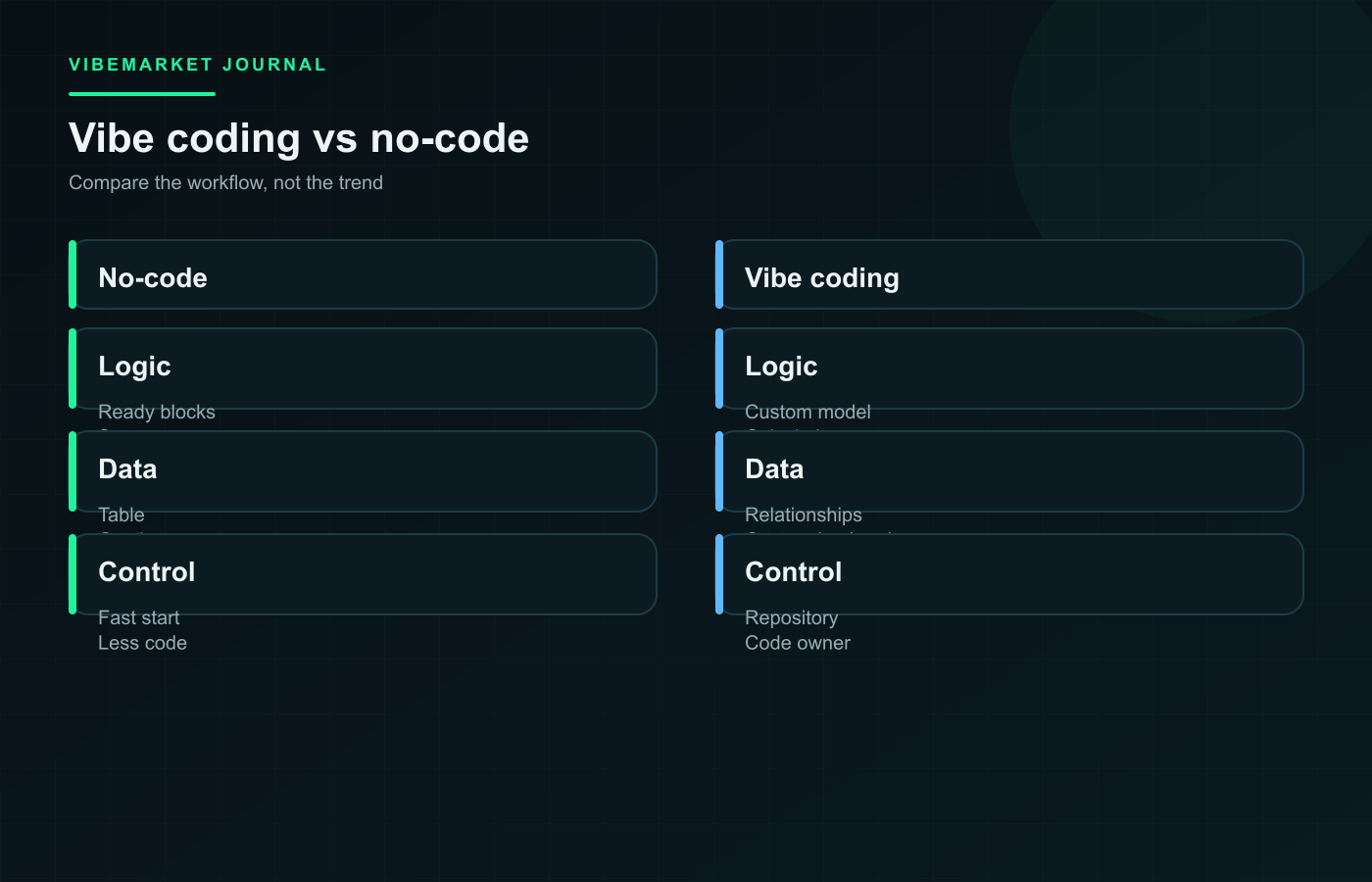
No-code defines the building blocks in advance. That is useful when the product fits forms, tables, roles, automations, and supported integrations. A team can reach a predictable result without owning as much infrastructure.
Vibe coding starts with describing behaviour, then using AI to create or change code. You can build a custom screen, data model, calculation, or integration. The trade-off is ownership: someone must read the code, run it in a clean environment, test it, and hand it over.
When no-code is the better choice
No-code is often the practical option when the product needs:
- a form, table, and a few statuses;
- a small internal workflow;
- notifications triggered by known events;
- a quick landing page or catalogue;
- integrations already available in the platform;
- a release that can be accepted by checking a few screens.
It is a strong way to test a process when learning speed matters more than implementation uniqueness. If the team already knows the platform and its limits do not hurt the core user workflow, switching just to get "real code" adds work without adding proof.
When vibe coding is the better choice
Vibe coding becomes more attractive when the product depends on its own logic. It may need several roles, a non-standard calculation, an unusual data model, or an interface that cannot be expressed by the platform's blocks.
It also makes sense when the team wants a repository and the ability to change behaviour without waiting for a platform feature. That freedom has a cost. You need branch rules, review, backups, secret management, and a person who decides what reaches Production.
The hybrid route
Many products can be split. Keep the marketing page and a simple internal form in no-code, then put the custom module in a separate application. Or use managed authentication and payments while building the customer portal and order rules yourself.
A hybrid approach reduces the amount of code you own without forcing the whole product into one platform. The price is another boundary. Document where the source of truth lives, how errors cross the boundary, who owns the keys, and what happens when one side is unavailable.
What changes as the product grows
Scale is not only more users. New roles and exports appear first. Audit and reporting may follow. Background jobs need a recovery plan, and another developer needs a clear handover.
No-code can become a bottleneck when important logic is hidden in many automations and hard to move. Vibe coding can become a bottleneck when code was produced faster than tests and documentation. In both cases, the core problem is unclear ownership and responsibility, not the tool label.
A decision matrix
| Question | Lean no-code | Lean vibe coding |
|---|---|---|
| Logic | Ready-made forms and statuses | Custom behaviour and calculations |
| Data | A simple table | A custom schema with relationships |
| Interface | Blocks are sufficient | A specific user workflow matters |
| Control | Speed of first release | Repository and change freedom |
| Team | No code owner | Someone accepts technical decisions |
Choose no-code when it covers the workflow without risky workarounds. Choose vibe coding when the platform constraint blocks the main product hypothesis and the team is ready to maintain code. A VibeMarket brief is stronger when it describes the user path, data, and success criteria instead of naming a favourite tool.
Discussion
Comments
No comments yet. Be the first to share your experience.
Sign in to join the discussion →