Vibe Coding vs Website Builders: When AI Gives You More Flexibility
When a website builder is enough and when data, roles, calculations, and AI-assisted development justify custom logic.
ContentsShow sections
For a service page, a website builder is often faster and calmer than custom development. The decision changes when the site must store data, calculate a price, expose different accounts, or trigger actions after a form. The question is no longer which template looks better. It is where the product logic lives.
When a website builder is enough
A builder is a good fit when the site is a clear public page:
- explain a company or service;
- show a portfolio or catalogue;
- collect a request by email or CRM;
- publish articles and SEO pages;
- test an offer and a landing-page structure.
In this scenario, the important features are editing, domain control, analytics, performance, and content updates. Custom code adds little value if the editor's main job is changing a headline and an image.
What vibe coding adds
AI-assisted development becomes useful when the website starts behaving like a product. A visitor may select service options, receive a calculation, create an account, view an order status, or upload documents. Vibe coding lets you describe that behaviour instead of forcing it into a prebuilt block.
You can create a custom data model, server-side checks, roles, unusual states, and integrations. AI can speed up the first pass and repeated changes, but the result still needs tests, access review, and a known runtime environment.
Where the builder starts to get in the way
The limit is not reached because a designer dislikes one font. It is reached when the product hypothesis depends on behaviour the platform cannot express without a chain of workarounds.
Typical signs include:
- critical logic spread across scripts, automations, and manual steps;
- the same data copied into several systems;
- roles that cannot be enforced on the server;
- an integration that works only on the happy path;
- a handover that depends on one account and private settings.
At that point, compare the cost of workarounds with a small custom application. It may be cheaper to keep the public page in the builder and move only the portal or form into a separate service.
The price of flexibility
Custom code is not only freedom. It is also a repository, environment variables, dependency updates, backups, monitoring, error handling, and access ownership. If the business has no owner for those responsibilities, "more flexibility" can turn into a fragile website.
A builder takes some of that work on, but you depend on its pricing, limits, editor, and export options. Confirm who owns the domain, where leads are stored, how data can be exported, and what happens when a contractor changes.
A practical decision
| Task | Practical choice |
|---|---|
| Service page and content | Website builder |
| Landing page with offer experiments | Builder or hybrid |
| Catalogue with a simple request | Builder if its blocks are enough |
| Customer account and statuses | Vibe coding or a separate application |
| Complex roles, calculations, and integrations | Controlled engineering with an owner |
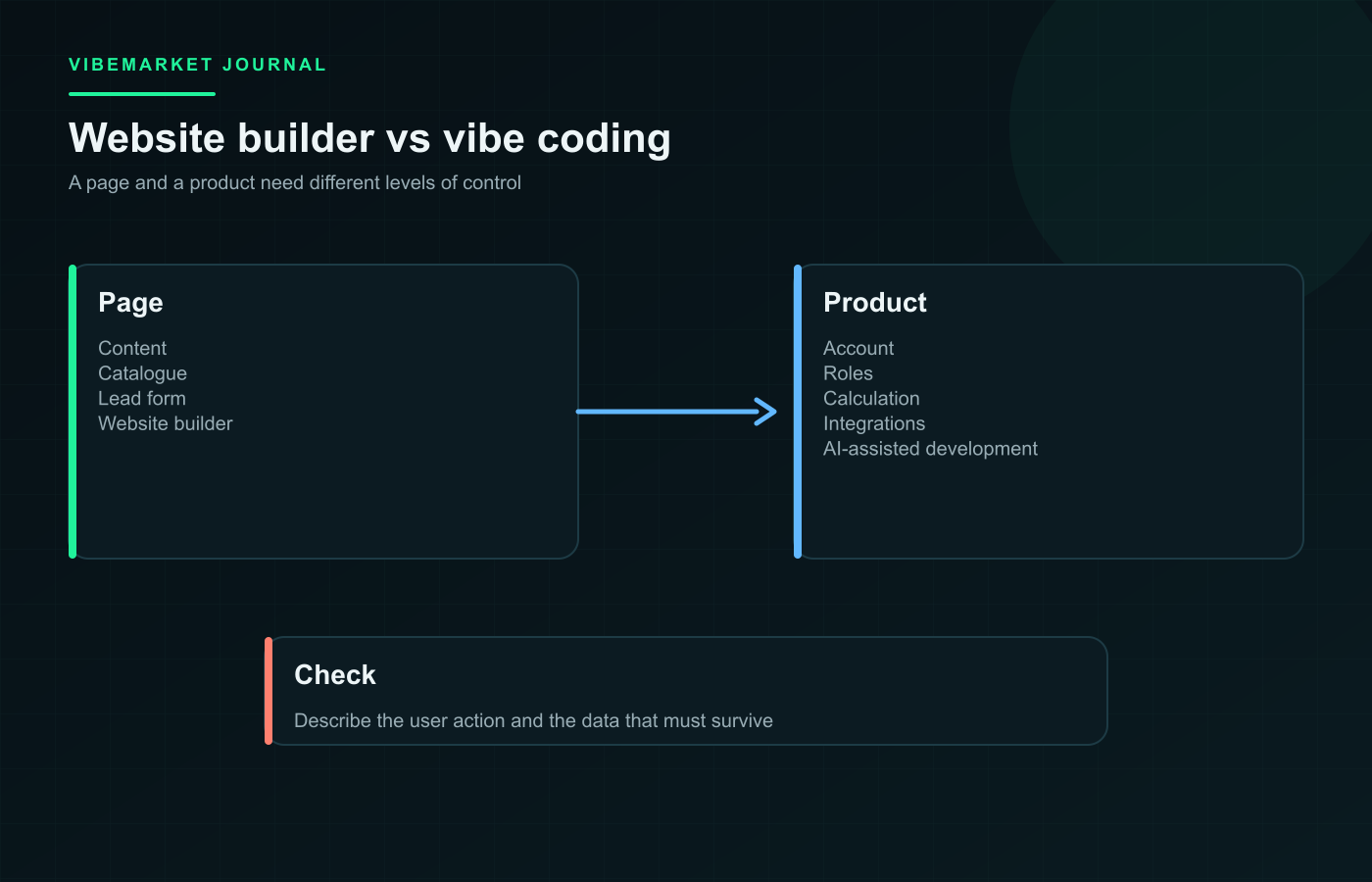
Describe the user action and the data that must survive it. If the action can be checked as a few screen states, a builder will probably work. If you need to prove permissions, retries, calculations, and recovery, choose a path where those rules can be tested directly.
A VibeMarket request is clearer when it asks for a specific user path instead of "a website built with AI." The developer can then explain which part should stay in the builder and which part needs code.
Discussion
Comments
No comments yet. Be the first to share your experience.
Sign in to join the discussion →